
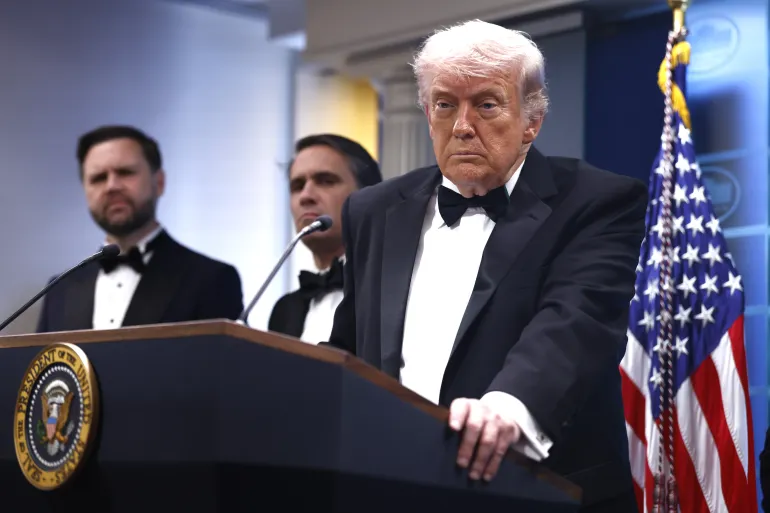
The shots rang out, and instead of ducking and disappearing like every protocol says he should, he stayed. Or at least, that’s how he tells it.
“I wanted to see what was going on,” Donald Trump said casually, almost like he was talking about a front-row concert seat, not a White House shooting.
That one line has done what Trump always does best: split the room instantly. Was it bravado? Was it recklessness? Or was it just classic Trump rewriting the moment in his own image?
This isn’t just another headline about a security scare. This is about how a sitting president frames danger, how power performs under pressure, and why the story being told after the chaos matters just as much as what actually happened during it.
Because when Trump says he didn’t run, he’s not just talking about a shooting. He’s talking about control.
BEFORE THE CHAOS, THIS WAS SUPPOSED TO BE A NORMAL NIGHT
The Donald Trump White House shooting didn’t start as a political moment. It started as what was supposed to be a polished, media-heavy evening the kind of event where politicians, journalists, and celebrities blur into one room and pretend, for a few hours, that everyone is on the same team.
Then everything broke.
According to Trump’s own retelling during his sit-down on 60 Minutes with Norah O’Donnell, the shooter identified by federal authorities as Cole Allen moved fast. Too fast. He reportedly slipped past medical detectors “in a blur” before opening fire.
Law enforcement responded quickly. The shooter was neutralized before anyone was seriously injured. On paper, that’s a security success story.
But the real tension came from what happened on stage.
While Vice President J.D. Vance was rushed out almost immediately standard protocol, no hesitation Trump’s exit didn’t look as clean. He appeared to stumble. To some watching live or on clips later, it looked chaotic.
Trump says that’s not what it was.
He insists the fall wasn’t panic. It was the Secret Service forcing him down.
And more importantly, he claims he didn’t want to leave at all.
THE REAL TEA: “I WANTED A FRONT ROW SEAT”
Here’s where the story gets very Trump bold, defiant, and just a little theatrical.
In that 60 Minutes interview, Donald Trump made it clear he wasn’t exactly cooperating with the people trained to keep him alive.
“I didn’t make it easy for them,” he admitted, referring to Secret Service agents trying to move him out of danger.
That line alone tells you everything about how he sees the moment. For Trump, this wasn’t just about survival. It was about presence.
He framed it like curiosity, saying he wanted to understand what was happening in real time. But critics will hear something else: a president treating a live threat like a spectacle.
And then came the detail that felt straight out of a late-night monologue. Trump joked that the alleged shooter, Cole Allen, was so fast that an NFL team should consider signing him.
Read that again. In the middle of recounting a shooting, there’s humor.
That contrast danger mixed with jokes is exactly why this moment is sticking. Some see it as confidence under pressure. Others see it as tone-deaf.
Meanwhile, Trump praised Melania Trump, calling her “strong” and “smart” for how she handled her first direct experience with a shooting. She wasn’t present during a previous assassination attempt in Butler, Pennsylvania, so this was new territory.
On the operational side, Trump gave credit where it’s due. He said the Secret Service did a “great job” stopping the threat quickly. And despite everything, he’s already planning to reschedule the White House Correspondents’ Dinner within 30 days.
That decision matters. It signals one thing: he’s not letting the moment define the event.
But the bigger question is whether his version of the moment is defining reality.
WHAT NOBODY IS SAYING ABOUT POWER AND PERFORMANCE IN A CRISIS
Here’s what the mainstream coverage is skimming past: this isn’t just about whether Trump moved fast enough or listened to security.
This is about performance.
Because in modern politics especially with someone like Donald Trump every crisis becomes a stage.
Think about it. The Vice President exits immediately. That’s institutional behavior. Clean, controlled, expected.
Trump, on the other hand, tells a story where he resisted leaving. Where he stayed curious. Where he almost positioned himself as a spectator in his own security scare.
That’s not accidental.
For audiences in places like Nigeria, the Caribbean, or anywhere politics already feels theatrical, this hits differently. Leaders aren’t just judged on decisions anymore they’re judged on how those decisions look in the moment.
And Trump understands optics better than most politicians alive.
So when he says, “I wanted to see what was going on,” he’s doing more than recounting events. He’s shaping an image: fearless, in control, unbothered.
Whether that image is accurate is almost beside the point.
Because once it’s out there, it sticks.
WHERE THINGS STAND NOW
Right now, the situation is technically under control.
The shooter has been identified. Law enforcement acted quickly. No mass casualties. On the surface, it’s a crisis that was contained before it spiraled.
The White House Correspondents’ Dinner is expected to be rescheduled within 30 days, which tells you the administration wants to move forward, not dwell.
But the conversation hasn’t moved on, it’s just shifted from the shooting itself to Trump’s reaction to it.
People aren’t just asking what happened. They’re asking whether a president should ever “want to stay and watch” during an active threat.
And that debate isn’t going anywhere soon.
My take? Trump didn’t just survive the moment he reframed it in a way only he can. Whether that’s leadership or showmanship depends entirely on what you value more.
FREQUENTLY ASKED QUESTIONS
Who is Donald Trump and why is he still so influential?
Donald Trump is a former U.S. president, businessman, and media personality who has remained a dominant force in American politics. Even outside traditional office cycles, his statements shape news cycles globally. His communication style direct, controversial, and often unpredictable keeps him at the center of attention. That influence is exactly why moments like the Whitehouse shooting get amplified through his perspective.
What exactly happened during the Whitehouse shooting event?
The Whitehouse shooting occurred during the Correspondents’ Dinner event when a suspect, identified as Cole Allen, reportedly rushed past security checkpoints and opened fire. Law enforcement quickly neutralized the threat, and no serious injuries were reported. President Trump later said he resisted being moved immediately because he wanted to see what was happening. That detail has become the most debated part of the incident.
Was Melania Trump present during the shooting?
Melania Trump was not present during the earlier assassination attempt in Butler, Pennsylvania, but Trump described her as “strong” and “smart” in handling this experience. This was her first direct exposure to such a situation tied to his presidency. Her reaction, while not heavily detailed publicly, was praised by Trump during his interview.
Did Trump really refuse to leave during the Whitehouse shooting?
Trump says he didn’t refuse outright, but he admitted he didn’t make it easy for the Secret Service to move him. According to his own words, he wanted to understand what was happening in real time. Critics argue that hesitation in such moments could increase risk, while supporters see it as composure. The truth likely sits somewhere in between a mix of instinct and personality.
What happens next after Trump says he wanted to see what was going on after WHCD shooting?
The immediate next step is the rescheduling of the Correspondents’ Dinner within 30 days, as Trump confirmed. Beyond that, the bigger impact is political and cultural how this moment shapes public perception of leadership under pressure. Trump’s framing of the event will likely continue to influence media narratives and public debate. And knowing his track record, he’s not done talking about it.
Some leaders run from danger. Some leaders get pulled away from it. And then there’s Trump — insisting he wanted a better view.
The real question isn’t whether he stayed. It’s why he wants us to believe he did.