2026 map reveals 750,000 Israelis in 500 illegal settlements across Palestine – implications
Background: The settlement enterprise and its legal status
Since the 1967 war, Israel has pursued a policy of building civilian communities on land captured from Jordan, Egypt and the former Ottoman Empire. International law, including the Fourth Geneva Convention, classifies these outposts as illegal because they involve the transfer of an occupying power's population into occupied territory, a point reiterated by the United Nations Security Council in resolutions such as 2334 (2016).
Over the decades, the settlement project has morphed from a handful of strategic outposts into a sprawling network that now blankets the West Bank, East Jerusalem and the Golan Heights. According to the Israeli human‑rights organization B'Tselem, more than 500 distinct settlements and outposts exist today, housing roughly three‑quarters of a million Israeli citizens.
The demographic weight of the settler population has turned the issue from a purely political dispute into a de‑facto reality on the ground. Each new housing unit not only expands the physical footprint of Israel but also entrenches a set of civil‑administrative structures that complicate any future two‑state solution.
The animated map: What the new visualisation shows
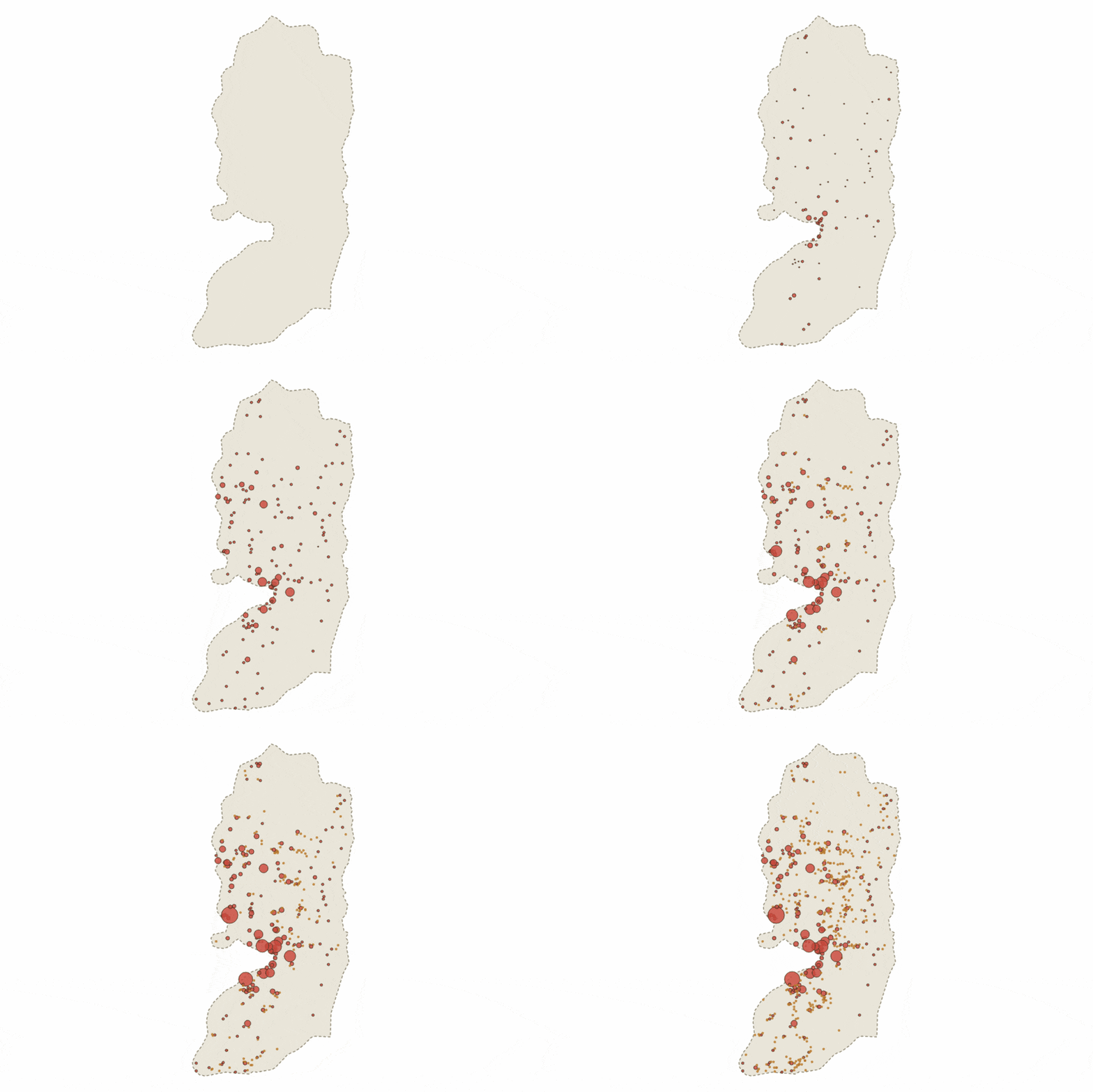
An interactive map released by a consortium of European NGOs on 10 September 2026 animates the growth of settlements from 1970 to the present day. Using satellite imagery and official Israeli land‑registry data, the map highlights when each settlement was founded, how many housing units were added each year, and the cumulative population of settlers.
The animation makes clear that the pace of expansion accelerated dramatically after 2009, when the Israeli government introduced a series of tax incentives for families moving into the West Bank. Between 2015 and 2022, more than 200,000 new settlers arrived, pushing the total to the current estimate of 750,000.
Beyond raw numbers, the map reveals a spatial pattern: settlements are increasingly clustered along major highways and near Israeli‑controlled water resources. This clustering not only fragments Palestinian territories but also creates "facts on the ground" that are difficult to reverse without massive relocation or compensation schemes.
Why the expansion matters beyond the immediate conflict
The settlement surge has direct implications for the viability of a contiguous Palestinian state. The World Bank’s 2024 report warned that the current settlement layout would leave a Palestinian territory consisting of 300 isolated enclaves, each lacking basic infrastructure. Such fragmentation undermines economic development, health services, and education for the roughly 5 million Palestinians living in the West Bank and Gaza.
Internationally, the settlements have become a flashpoint in diplomatic relations. The United States, under its 2025 foreign‑policy review, signalled a shift toward conditioning military aid on settlement freezes, while the European Union has threatened to withhold funding for Israeli‑occupied‑territory projects unless settlement activity is halted. The map’s visual impact is being used by diplomats to illustrate the urgency of those policy levers.
The growth also fuels a broader narrative of land‑grab that resonates with other contested regions worldwide. Scholars point to the Palestinian case as a template for how state‑backed settlement can be used to alter demographic realities, a pattern echoed in parts of the South China Sea, Kashmir and, increasingly, in African land‑use disputes.
African parallels: Land grabs, diaspora reactions, and market implications
African observers see a striking similarity between Israel’s settlement strategy and the way multinational corporations, often backed by foreign governments, acquire large tracts of land in Africa for agriculture, mining or infrastructure. In Kenya’s Tana River Basin, for example, a 2023 deal granted a foreign agribusiness rights to over 30,000 hectares, prompting protests over displacement of local farmers. Both cases involve legal loopholes, state incentives, and the marginalisation of indigenous populations.
The Palestinian diaspora in Africa, particularly in South Africa and Kenya, has mobilised around the settlement issue. Community organisations have organised solidarity concerts and art exhibitions, arguing that the fight against illegal settlements mirrors anti‑colonial struggles across the continent. Their activism has helped push African Union member states to call for an emergency UN debate on the matter at the 2026 AU summit in Addis Ababa.
From a financial perspective, the settlement boom influences African investors with exposure to Israeli real‑estate funds or companies operating in the occupied territories. Several Israeli construction firms listed on the Tel Aviv Stock Exchange have seen their share prices rise by double‑digit percentages since 2022, attracting interest from African sovereign wealth funds seeking high returns. However, ESG‑focused investors are warning that exposure to settlement‑linked assets could trigger reputational risk and divestment pressures.
Reactions and what comes next: Diplomatic, legal and grassroots avenues
The release of the animated map prompted immediate condemnation from the United Nations Office for the Coordination of Humanitarian Affairs, which called the visualisation “a stark reminder that the occupation is deepening, not receding.” The UN urged the Security Council to convene an emergency session to discuss possible sanctions against settlement‑building companies.
In Jerusalem, Prime Minister Benjamin Netanyahu’s coalition defended the expansion as “a legitimate exercise of Israel’s historic and security‑related rights.” Yet even within the coalition, moderate Knesset members have signalled discomfort, citing the risk of international isolation and the financial cost of maintaining outposts that lack basic services.
On the ground, Palestinian civil‑society groups are leveraging the map to organise legal challenges. A coalition of NGOs has filed a petition with the International Court of Justice, arguing that the settlements constitute a breach of the prohibition on the acquisition of territory by force. Meanwhile, grassroots campaigns such as “Stop the Outpost” are using social‑media hashtags to pressure Israeli consumers to boycott products made in settlement factories.
Quick Answers
How many Israeli settlers live in illegal settlements as of 2026?
Around 750,000 Israelis reside in more than 500 settlements and outposts deemed illegal under international law.
Why do the settlements matter for a future two‑state solution?
Their spread fragments Palestinian territory, making a contiguous, viable Palestinian state increasingly impossible without massive land swaps or evacuations.
Is there any African connection to the Israeli settlement issue?
African observers draw parallels with land‑grab practices on the continent, and the Palestinian diaspora in Africa is actively campaigning against the settlements.
Source: www.aljazeera.com




💬 Comments 0