
“Hey, it’s Taylor.”
That simple, almost casual phrase might soon be one of the most protected pieces of intellectual property in pop culture. Not a song. Not an album. Just… her voice.
Because right now, the biggest threat to Taylor Swift isn’t another artist, it’s AI learning how to sound exactly like her.
And she’s not waiting around to see how that plays out. Behind the scenes, paperwork is moving fast, signatures are being filed, and a legal wall is being built around something most artists have never even tried to own: the sound of themselves.
This isn’t just a celebrity filing trademarks. This is a superstar drawing a line in the sand about identity in the age of artificial intelligence.
What you’re about to read isn’t just about trademarks, it’s about control, ownership, and what happens when technology gets a little too good at pretending to be human.
BEFORE AI COULD SING LIKE YOU, THIS WASN’T EVEN A CONVERSATION
For most of music history, your voice was just… yours.
Nobody could copy it, clone it, or remix it without you physically being in the room. But AI has changed that equation overnight. Suddenly, voices are data. And data can be trained, replicated, and if nobody steps in, public figure voices will be monetized.
That’s where Taylolr Swift (yes, even the way people misspell her name online says a lot about how searchable and global she is) enters this moment.
The idea of Taylor Swift trademark her voice and image because of AI isn’t random. It’s a direct response to how fast things are shifting.
We’ve already seen AI-generated songs that mimic real artists floating around the internet. Some are impressive. Some are scary. All of them raise the same question: who owns a voice when a machine can recreate it?
And here’s the twist, not every celebrity is fighting it.
Actors like Michael Caine and Matthew McConaughey have actually partnered with ElevenLabs to create digital versions of their voices. That’s collaboration, not resistance.
So now you’ve got two lanes:
Artists embracing AI as a tool.
And artists like Swift making sure AI doesn’t run off with their identity unchecked.
That tension? That’s the real story.
THE REAL TEA: THREE TRADEMARKS, ONE CLEAR MESSAGE
Let’s get into what actually happened because this wasn’t just a vague move. It was precise.
According to a report from Variety, Taylor Swift filed three trademark applications through her company, TAS Rights Management, with the U.S. Patent & Trademark Office on April 24.
Two of them are all about her voice.
One covers the phrase:
“Hey, it’s Taylor Swift.”
The other?
“Hey, it’s Taylor.”
Simple. Personal. Instantly recognizable.
And that’s exactly the point, she’s trying to lock down the most human, relatable parts of her brand before AI turns them into templates.
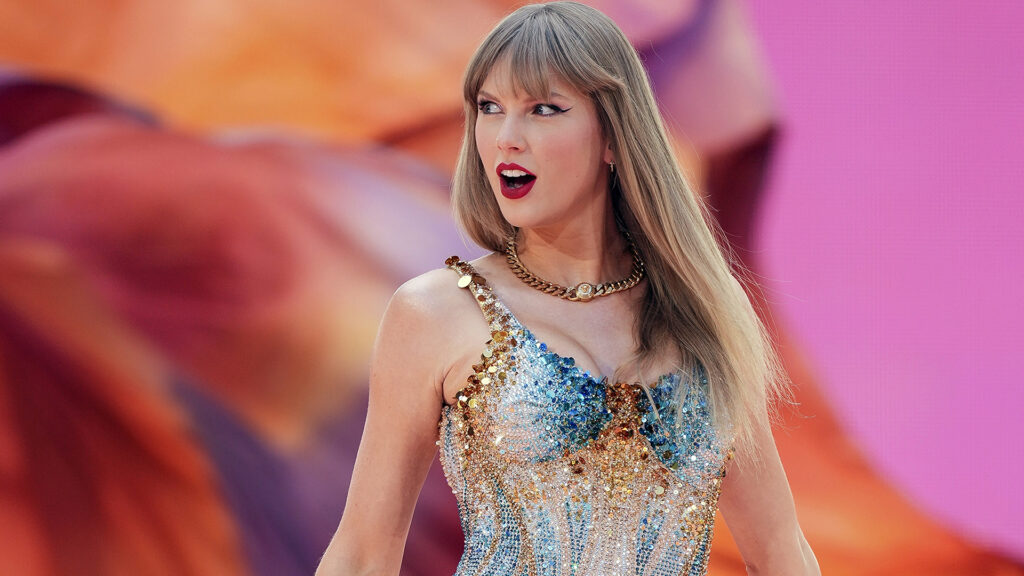
Then there’s the third trademark, and this one is visual. It protects a very specific image: Swift holding a pink guitar, wearing a multi-colored iridescent bodysuit with silver boots, standing on a pink stage with a multi-colored microphone and purple lights behind her.
That level of detail isn’t accidental. It’s strategic.
Trademark attorney Josh Gerben explained it clearly on his firm’s blog. He said that if AI uses a voice that sounds like Swift’s, she could argue it violates her trademark rights, not just her likeness, but her sound.
Think about that for a second.
We’re moving into a world where sounding like someone could be treated the same way as copying their logo.
And the visual trademark? Same idea. If AI-generated images start producing “Swift-like” visuals the pose, the outfit, the vibe… her team now has extra legal ground to push back.
This isn’t just protection. It’s preemptive defense.
Because once AI content floods the internet, trying to clean it up later is almost impossible.
WHAT NOBODY IS SAYING ABOUT THIS AI FIGHT
Here’s what mainstream coverage is dancing around:
This isn’t just about Taylor Swift. This is about who gets left behind.
What nobody is saying out loud is that only the biggest stars can afford to protect themselves like this.
Swift has the resources, the legal teams, the foresight. She can trademark phrases, visuals, and vocal identity before things spiral.
But what about smaller artists?
What about the singer in Lagos, Kingston, or São Paulo whose voice gets scraped into an AI model without permission?
They don’t have TAS Rights Management. They don’t have teams filing three trademarks in a single day.
And culturally, this hits different outside the West. In African and Caribbean music scenes especially, voice and style are deeply tied to identity accents, slang, delivery.
If AI starts copying that without credit or control, it’s not just a legal issue. It’s cultural extraction.
Swift’s move might look like self-protection and it is, but it also quietly highlights a growing gap in the industry:
Who gets to own themselves in the age of AI, and who doesn’t?
Right now, these trademark applications are filed not finalized. That process takes time, and there’s no guarantee every detail will go through exactly as submitted.
But the message has already landed. Loudly.
Taylor Swift trademark her voice and image isn’t just a headline. It’s a warning shot to the entire entertainment industry.
Meanwhile, AI keeps evolving. More tools. Better voice cloning. More realistic outputs. And more artists quietly figuring out whether to fight it or join it.
The mood? A mix of excitement and anxiety.
Some see opportunity. Others see a future where originality becomes harder to prove.
My honest take? Swift is playing this smarter than most. She’s not reacting late, she’s moving early. And in a space moving this fast, early might be the only advantage that matters.
FREQUENTLY ASKED QUESTIONS
Who is Taylor Swift and why is she so influential?
Taylor Swift is one of the biggest global music stars of her generation, known for her songwriting, storytelling, and business control over her work. Beyond music, she’s shaped how artists think about ownership, especially after re-recording her albums. That’s why moves like Taylor Swift trademark her voice and image carry industry-wide weight, people pay attention when she acts.
Why is Taylor Swift trademarking her voice and image because of AI?
The main reason is protection. AI can now replicate voices and visuals with scary accuracy, and Swift is trying to legally block unauthorized use. By trademarking phrases like “Hey, it’s Taylor,” she creates a legal argument against AI-generated content that sounds like her. It’s a way to stay in control before things get messy.
Are other celebrities working with AI instead of fighting it?
Yes, and that’s what makes this interesting. Actors like Michael Caine and Matthew McConaughey have partnered with ElevenLabs to create AI voice versions of themselves. So while Taylor Swift trademark her voice and image because of AI, others are choosing to collaborate with the technology instead of restricting it.
Does trademarking a voice actually work legally?
It’s not fully tested yet at scale, but it’s a clever move. Trademark law usually protects things that identify a brand, like a slogan or logo. Swift’s team is basically arguing that her voice and phrases are part of her brand identity. If courts agree, it could change how voice rights are handled moving forward.
What happens next for Taylor Swift and AI in music?
Expect more artists to follow her lead, especially at the top level. If her trademarks are approved, it could start a trend of musicians protecting their voices and likenesses. The bigger question is whether laws will catch up fast enough to keep AI in check or if artists will have to keep fighting case by case.
This isn’t just about one pop star protecting her brand . It’s about the moment we all realize identity itself is becoming something you have to legally defend.
And if Taylor Swift is already locking hers down, the real question is: who’s next… and who won’t even get the chance?
[…] the very top, you still find Taylor Swift, and it’s not even close when you factor in everything. Her catalogue alone pulls billions of […]