Bauchi police arrest two men over stolen cattle and bribery attempt in Alkaleri, 2026
Cattle theft as a growing security headache in northern Nigeria
Livestock remains the backbone of many rural economies across northern Nigeria, where pastoralists and farmers depend on cattle for income, food security, and cultural identity. In the past decade, the theft of cattle, goats and sheep has surged, driven by organized crime networks, porous borders with neighboring countries, and the increasing value of live animal trade. According to the Nigerian Institute of Social and Economic Research, the country loses an estimated $1.2 billion a year to livestock crimes, a figure that eclipses losses from many other informal sectors.
The problem is compounded by chronic under‑resourcing of rural policing, limited forensic capacity to trace stolen animals, and a history of distrust between herders and law‑enforcement agencies. When thefts go unchecked, they fuel inter‑communal tensions, especially between Fulani herders and sedentary farming communities, sometimes sparking retaliatory attacks that draw national attention. The federal government has introduced a few pilot anti‑theft units, but implementation remains uneven, leaving states like Bauchi to shoulder the frontline response.
The Alkaleri incident: two suspects nabbed and a bribery attempt recorded
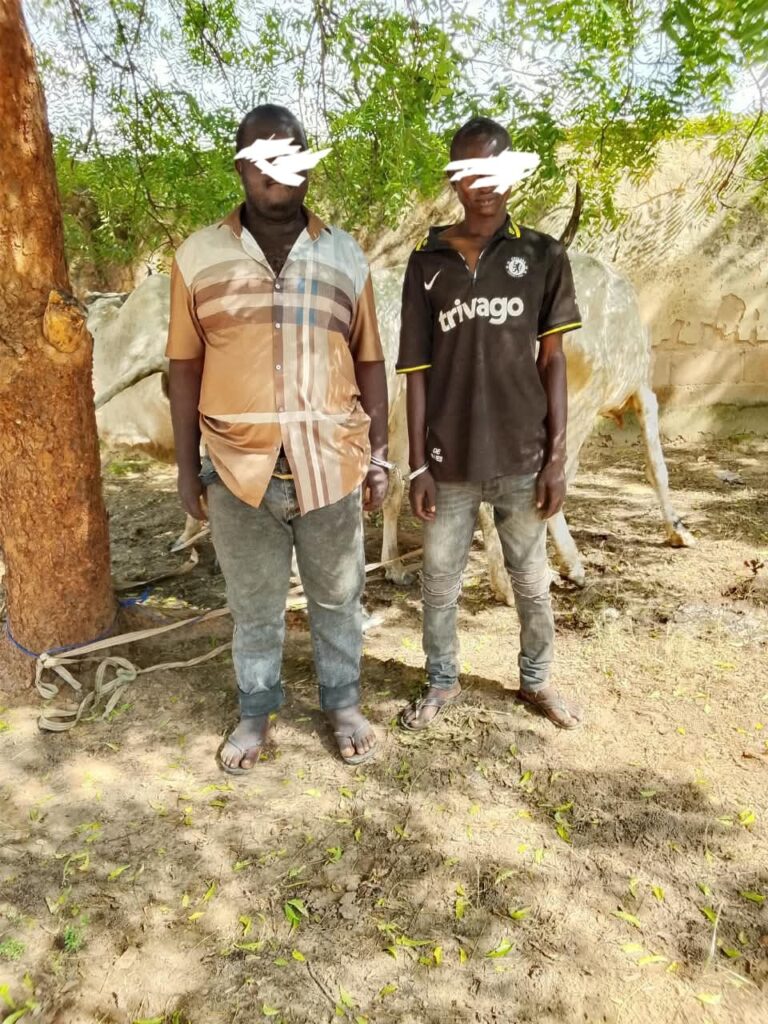
On a quiet morning in late July 2026, officers of the Bauchi State Police Command conducted a routine patrol in Alkaleri Local Government Area when they received an anonymous tip about two men moving with a herd of cattle that did not belong to any known farmer in the vicinity. The suspects, identified as 26‑year‑old Abdullahi Adamu and 20‑year‑old Muktashir Idris of Jarmai Village in Plateau State’s Dangi LGA, were stopped and questioned. Police reports say the men could not produce valid ownership documents for the animals, prompting a deeper investigation.
During the encounter, the men allegedly offered the officers a sum of cash in exchange for letting them go, an act the police described as an attempted bribe. According to a spokesperson for the Bauchi Command, the suspects tried to hand over a bundle of newly minted Naira notes, but the officers rejected the offer and placed them in custody. Both men are now being held at the Alkaleri police station pending formal charges of cattle theft and attempted corruption of a public officer.
Why this arrest matters for the local economy and governance
The seizure of two alleged cattle thieves sends a clear signal to criminal syndicates that law‑enforcement is willing to act, even in remote locales where such crimes have traditionally gone unpunished. For pastoralists, the move could restore a measure of confidence that stolen livestock will be recovered, or at the very least that thieves will face legal consequences. This is critical because loss of cattle directly translates into reduced milk production, fewer draft animals, and a dent in household incomes that already hover near subsistence levels.
From a governance perspective, the reported bribery attempt underscores the endemic challenge of corruption within the police force itself. By refusing the bribe and publicising the incident, Bauchi authorities aim to demonstrate a zero‑tolerance stance that aligns with President Bola Tinubu’s broader anti‑corruption agenda announced earlier this year. If the case leads to convictions, it could set a precedent that deters would‑be offenders from trying to buy their way out of accountability, thereby strengthening the rule of law in a region where trust in institutions is fragile.
Community and official reactions to the crackdown
Local leaders in Alkaleri, including the traditional council chairman, welcomed the arrests, describing them as “a decisive step toward safeguarding our herders and our children’s future.” Residents of Jarmai Village, where the suspects hail from, expressed mixed feelings: while some condemned the alleged crime, others warned that heavy‑handed policing could strain inter‑state relations between Bauchi and Plateau, especially if families feel targeted.
State officials have pledged to follow up with swift prosecution. The Bauchi State Commissioner of Police, in a press briefing, said the department would collaborate with the Plateau State Police Command to trace any wider network linked to the duo. Meanwhile, civil‑society groups such as the Nigerian Farmers Association called for a regional task force that combines police, veterinary officers, and community elders to address livestock crime holistically, rather than relying solely on punitive measures.
What lies ahead: legal process, policy reforms and the broader fight against livestock crime
The two suspects are scheduled to appear before a magistrate in Alkaleri next week, where they could be charged under the Criminal Code for theft and under the Public Officer Corruption Act for the attempted bribe. If convicted, sentencing could range from five to ten years of imprisonment, reflecting recent judicial trends that impose harsher penalties for crimes that threaten food security.
Beyond the courtroom, the case could catalyse policy action at the state and federal levels. Analysts suggest that Bauchi may soon pilot a GPS‑tracking system for high‑value cattle, a technology already trialled in parts of the Sahel to deter cross‑border smuggling. Additionally, the incident may push lawmakers to amend existing livestock‑theft statutes, introducing mandatory restitution clauses that obligate offenders to pay market‑value compensation to victims. Such reforms would not only protect pastoralists but also create a more transparent environment for livestock trade across West Africa.
Quick Answers
What charges are the arrested men facing in the Bauchi cattle theft case?
They are expected to be charged with cattle theft under the Criminal Code and attempted bribery of a public officer under the Corruption Act.
How does cattle theft impact rural economies in northern Nigeria?
Livestock loss reduces household income, cuts milk and meat supply, and can trigger inter‑communal conflicts, undermining food security and local development.
What steps is the Bauchi State Police planning to take after the arrests?
The command says it will work with Plateau authorities to investigate any wider theft network and explore technology‑based tracking to deter future crimes.
Source: dailypost.ng



💬 Comments 0