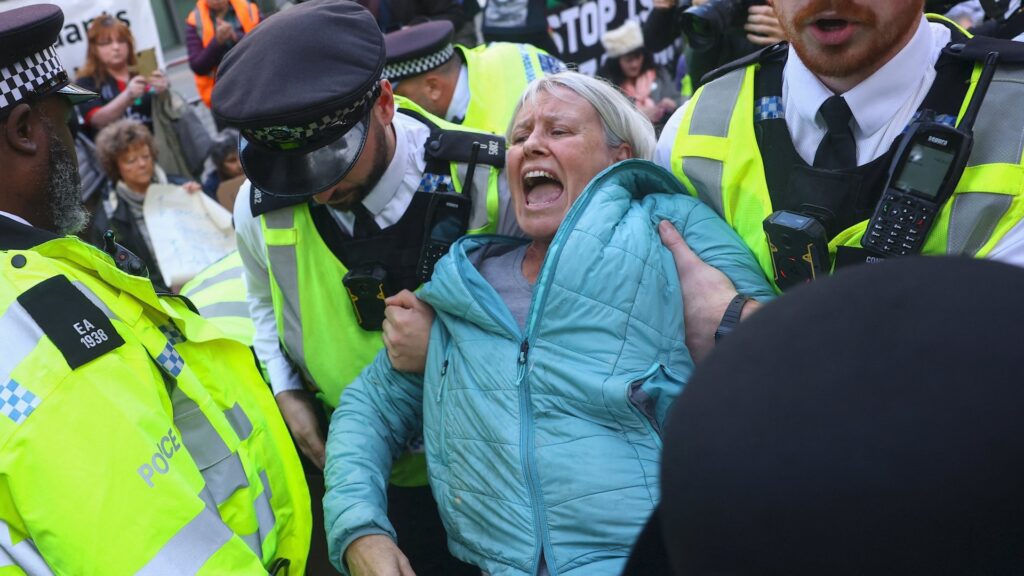
Palestine Action supporters arrested outside US embassy in London, 2026 protest
Background: the UK ban on Palestine Action
In March 2026 the British Home Office invoked the Terrorism Act to designate the activist network Palestine Action as an extremist group, effectively banning its public demonstrations across the United Kingdom. The decision followed a series of high‑profile disruptions at ports and airports that the government said threatened public safety and trade. Critics, including human‑rights NGOs, argued the move was a disproportionate response to peaceful civil‑disobedience aimed at highlighting the Israeli‑Palestinian conflict.
The ban gave police powers to arrest anyone suspected of organizing or participating in Palestine Action activities, even if they were merely present at a rally. Legal experts warned that the measure could set a precedent for curbing other protest movements, especially those linked to foreign policy issues. The decision also sparked a wave of solidarity protests among student groups, trade unions and diaspora communities who view the ban as an attack on free speech.
London, home to one of the largest Palestinian diasporas in Europe, became a focal point for the backlash. Earlier protests at the Israeli embassy and at major ports had already drawn thousands of demonstrators, and the ban galvanized a broader coalition of activists who see the UK’s stance as aligning too closely with US foreign policy.
The London demonstration: what unfolded at the US embassy
On 30 October 2026, an estimated 500 people gathered outside the US embassy on Nine Elms, chanting slogans such as “End the occupation” and “Free Palestine”. Organisers, who described the rally as a “solidarity march against the UK ban”, called for the release of arrested activists and for the Home Office to reverse its decision.
Police deployed a mixture of mounted units and riot control officers. Within the first half‑hour, officers moved in to detain several demonstrators who were holding banners that displayed the Palestine Action logo. By the end of the evening, Metropolitan Police reported that 37 people had been arrested, most on suspicion of breaching the ban, with a handful charged under the Terrorism Act for alleged “support of extremist activity”.
Video footage shared on social media showed a tense standoff, with some protesters attempting to breach the embassy’s security perimeter. While no violence was reported, the presence of US diplomatic staff added a layer of diplomatic sensitivity, prompting the Foreign Office to issue a brief statement urging “peaceful expression of views in accordance with the law”.
Why it matters for UK politics and foreign policy
The arrests highlight a growing friction between the UK’s domestic security agenda and its reputation as a liberal democracy that protects protest rights. Opposition parties have already pledged to question the Home Office’s use of anti‑terror legislation on civil‑disobedient groups, arguing that it could erode public trust in law‑enforcement agencies.
Internationally, the incident puts the UK in a delicate position with its key ally, the United States. The US embassy’s proximity to the protest site meant that any escalation could be interpreted as a direct challenge to US‑UK diplomatic cooperation, especially as both nations navigate the fallout from the Israel‑Gaza war. Analysts at the Royal United Services Institute noted that the UK may face pressure to balance security concerns with its commitment to uphold human‑rights standards in foreign‑policy debates.
Economically, the ban and the subsequent protests could affect trade routes that Palestine Action previously targeted, such as the Port of Felixstowe. Shipping companies have warned that heightened security checks could increase costs, a factor that may ripple through the UK’s logistics sector, which employs a sizable number of workers from African and Caribbean backgrounds.
African diaspora solidarity and the wider pattern of protest
African and Caribbean communities in London have a long history of aligning with Palestinian solidarity movements, seeing parallels between colonial legacies and current occupation narratives. At the 2026 rally, several Ghanaian and Nigerian student groups displayed flags alongside Palestinian banners, underscoring a shared sense of anti‑imperialism.
The protest also dovetails with a broader wave of activism across Europe, where African‑origin NGOs have been vocal against what they perceive as Western double standards on human rights. According to a statement from the African Diaspora Network in the UK, the ban on Palestine Action “mirrors attempts to silence Black and Brown voices that challenge the status quo on global justice”.
In South Africa, university campuses have organized teach‑ins on the UK ban, linking it to the legacy of apartheid‑era suppression of dissent. These cross‑continental connections suggest that the London arrests could energise a transnational network of activists who view the UK’s approach as part of a larger trend of curbing progressive movements.
What comes next: legal battles and future activism
Legal experts expect a series of judicial reviews to challenge the Home Office’s designation of Palestine Action. Civil‑liberties groups such as Liberty have already filed a claim arguing that the ban violates the European Convention on Human Rights, particularly the right to peaceful assembly. A court ruling in favor of the activists could force the government to amend its anti‑terror framework.
Meanwhile, activists are planning a coordinated “Day of Defiance” on 15 November, targeting multiple embassies in London, including those of Israel and the United States. Organisers say they will employ non‑violent tactics—such as sit‑ins and symbolic art installations—to avoid further arrests while keeping public attention on the ban.
The diplomatic fallout may also prompt the US State Department to issue a formal protest, as it monitors the treatment of demonstrators near its embassy. If tensions rise, the UK could face calls from parliamentary committees to review its cooperation with US security agencies, especially regarding the sharing of intelligence on protest groups.
Quick Answers
Why were Palestine Action supporters arrested outside the US embassy in London?
They were detained under the UK’s 2026 ban on Palestine Action, which allows police to arrest anyone suspected of supporting the extremist‑designated group.
How does the UK ban on Palestine Action affect African diaspora communities?
Many African and Caribbean groups see the ban as part of a wider crackdown on anti‑imperial activism, linking it to historic struggles against colonial oppression.
What legal options do the arrested protesters have?
Civil‑liberties organisations have filed judicial reviews, arguing the ban breaches human‑rights protections under the European Convention on Human Rights.
Source: www.aljazeera.com


💬 Comments 0