Trump meets Xi in 2026 summit as US and China race for AI supremacy, impact on Africa in global tech race
Background: AI as the new strategic frontier
Artificial intelligence has moved from a niche research topic to a core element of national security, economic growth and diplomatic leverage. In the past decade the United States and China have each poured billions of dollars into AI labs, talent pipelines and chip manufacturing, turning the technology into a de‑facto arms race. The competition is not just about faster algorithms; it encompasses data sovereignty, export controls and the ability to set global standards for everything from facial‑recognition ethics to autonomous weapons.
The race intensified after the launch of China’s “New Generation Artificial Intelligence Development Plan” in 2017 and the U.S. release of the “American AI Initiative” in 2019, both of which pledged to make their respective countries the world’s AI superpowers by 2030. Since then, AI patents, venture capital flows and government‑backed research have surged, creating a feedback loop where each side tries to out‑spend and out‑innovate the other.
For many observers, the AI duel is now the most consequential geopolitical rivalry since the Cold War, because the technology can reshape labour markets, influence public opinion and even dictate the rules of future conflicts. This backdrop explains why AI dominated the agenda when former President Donald Trump and Chinese President Xi Jinping sat down for a bilateral meeting in Washington this week.
The Trump‑Xi summit: why AI dominated the agenda
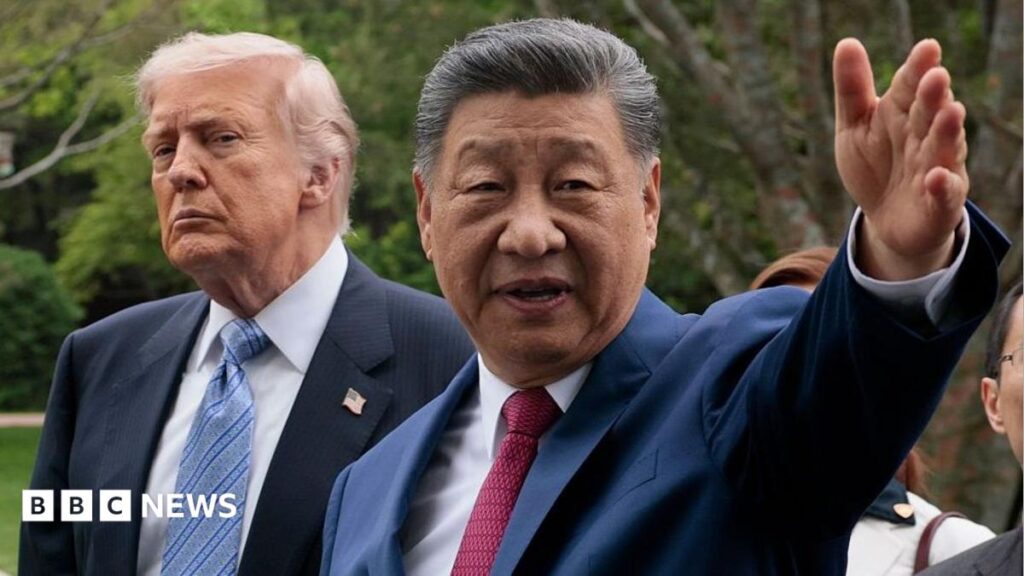
The meeting, the first in‑person encounter between the two leaders since 2021, was billed as a chance to defuse tensions over trade, Taiwan and climate. Yet, according to a briefing from the U.S. State Department, AI and emerging technologies quickly eclipsed those topics, with both sides presenting draft frameworks for a bilateral AI safety pact.
Trump, who has signalled a willingness to relax some export restrictions on semiconductor equipment, hinted at a possible “AI‑first” trade corridor that would allow U.S. firms to sell certain chips to Chinese partners under strict monitoring. Xi, on the other hand, stressed China’s “responsible innovation” narrative and warned against a fragmented global AI landscape that could marginalise developing nations.
Analysts from the Carnegie Endowment noted that the dialogue was less about immediate policy agreements and more about signalling to allies and rivals that each superpower remains the primary architect of the AI order. The summit therefore set the stage for a series of follow‑up negotiations on data sharing, joint research labs and standards‑setting bodies such as the International Telecommunication Union.
Implications for African tech ecosystems
Africa’s burgeoning AI startup scene—now home to over 400 firms according to the African Development Bank—stands at a crossroads. The U.S. and China are the two largest sources of venture capital for the continent, together accounting for roughly 70% of AI‑related funding in 2025. A shift in the global AI balance could redirect those flows, either amplifying Chinese investment in African data centres or prompting U.S. firms to deepen partnerships with African universities to secure talent pipelines.
Moreover, the standards debate has direct relevance for African regulators. If the United States pushes a model that privileges open‑source transparency while China advocates a model that leans on state‑owned data pools, African ministries will have to choose which framework aligns with their digital‑sovereignty goals. The African Union’s recent “Digital Transformation Strategy 2030” already calls for home‑grown AI guidelines, but implementation will be shaped by whichever superpower’s standards become dominant in global trade agreements.
A practical impact is already visible in the telecom sector. Several West African carriers are negotiating with Chinese equipment makers for 5G‑ready AI edge servers, while U.S. firms such as NVIDIA are courting African cloud providers for joint AI‑as‑a‑service offerings. The outcome of the Trump‑Xi talks could tip the balance toward one set of hardware suppliers, influencing the cost and speed of AI adoption across the continent.
Geopolitical ripple effects: trade, standards and talent
If the United States relaxes its semiconductor export curbs, Chinese AI firms could gain faster access to high‑performance chips, narrowing the hardware gap that has long given U.S. companies an edge. That scenario would likely intensify competition for AI talent worldwide, prompting African researchers to receive more overseas offers and potentially accelerating brain‑drain unless local institutions can match salaries and research facilities.
Conversely, a joint AI safety pact could open a regulated channel for technology transfer, allowing African governments to import vetted AI tools without fearing inadvertent sanctions. Such a pathway would be especially valuable for health‑tech initiatives that rely on machine‑learning diagnostics, a sector where the World Health Organization estimates AI could improve disease‑detection accuracy by up to 30% in low‑resource settings.
Trade ministries across the continent are already drafting contingency plans. Kenya’s Ministry of ICT, for example, announced a review of its import tariffs on AI chips, while Nigeria’s National Information Technology Development Agency is consulting with both U.S. and Chinese partners to design a dual‑licensing model that would safeguard data privacy while keeping costs competitive.
What comes next: policy moves and African agency
In the weeks ahead, the United States is expected to release a revised “Export Control Reform Act” that could carve out exceptions for AI research collaborations with trusted partners, a move that may benefit African universities that have existing joint programmes with U.S. labs. China is likely to issue a white paper on “AI Governance for Developing Nations,” a diplomatic effort to position itself as a partner for African digital development.
For African policymakers, the key takeaway is the need to build home‑grown AI capacity before external standards lock the continent into a single geopolitical camp. Initiatives such as the Pan‑African AI Institute, launched in 2024, aim to train 10,000 AI engineers by 2030 and to create a continent‑wide data commons that could serve as a bargaining chip in future negotiations. By controlling their own data ecosystems, African nations can demand a seat at the table when global AI rules are drafted.
Ultimately, the Trump‑Xi summit underscores that AI is no longer a peripheral tech issue but a core element of global power politics. The decisions made in Washington and Beijing will reverberate through African markets, research labs and policy circles for years to come, making it essential for African leaders to engage proactively rather than reactively.
Quick Answers
How might the US‑China AI rivalry affect African startups?
It could shift investment flows, hardware supply chains and standards, prompting African AI firms to align with either U.S. or Chinese ecosystems depending on which offers better access to chips, data and markets.
What is the potential impact of a US‑China AI safety pact on African governments?
A pact could create a regulated pathway for technology transfer, allowing African states to import AI tools with fewer sanctions risks while still complying with agreed‑upon safety standards.
Why should African policymakers care about AI standards being set by the US and China?
Global AI standards will dictate data privacy rules, export controls and market access, so the choices made by the superpowers will directly shape Africa’s ability to protect its digital sovereignty and attract foreign investment.
Source: www.bbc.co.uk




💬 Comments 0