Catholic bishops apologise for ‘exploited’ Trump meeting – Bishop Robert McElroy & Bishop Joseph Strickland say they were misled, 2026 fallout
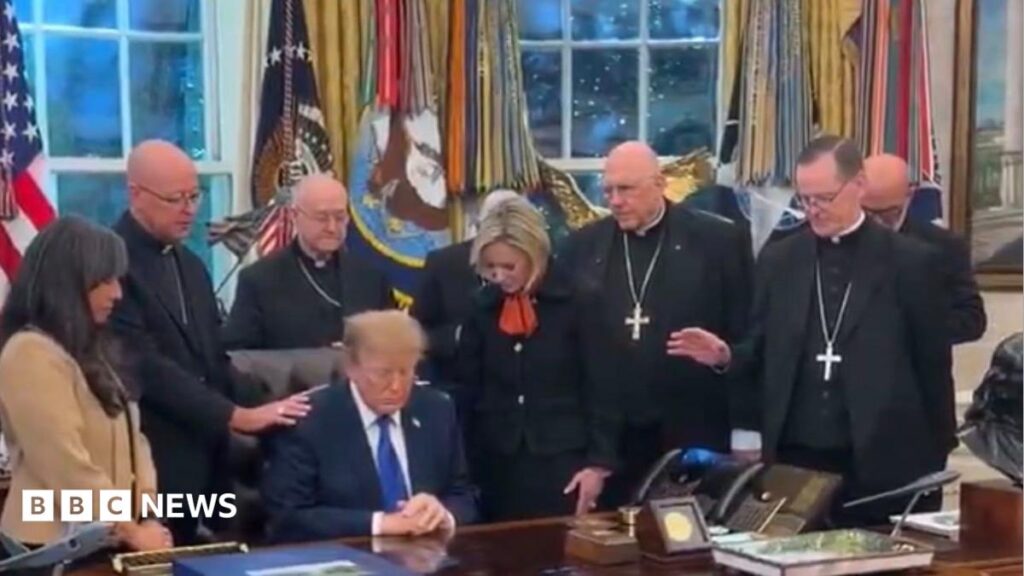
Background: The photo that sparked a backlash
In July 2024 a widely circulated photograph showed U.S. President Donald Trump kneeling beside two Catholic prelates – Bishop Robert McElroy of San Diego and Bishop Joseph Strickland of Texas – during a private audience at the White House. The image was posted by a pro‑Trump account and quickly turned into a meme, suggesting the bishops had endorsed the former president’s polarising policies. The picture was used in political ads, social media campaigns and even in sermons across the United States to argue that the Catholic hierarchy was complicit in Trump’s rhetoric on immigration, abortion and LGBTQ rights.
The bishops later claimed they had believed the meeting to be a private, non‑political audience. Both issued statements in early October 2026 apologising for the way the photo was “exploited” by the media and political operatives. Their apology came after a series of inquiries from the U.S. Conference of Catholic Bishops (USCCB) and a growing chorus of criticism from Catholic laity who felt the Church had been used as a political prop.
The episode resurfaced at a time when the Catholic Church in the United States is grappling with internal divisions over social doctrine, the role of bishops in electoral politics, and the impact of Pope Francis’ emphasis on climate justice and economic inequality. The controversy therefore touches on a broader struggle: how religious authority is mobilised in a hyper‑partisan environment.
Why the apology matters for American Catholics
For many American Catholics, especially the growing Hispanic and African‑American constituencies, the image of Trump kneeling before bishops reinforced a perception that the hierarchy favours conservative politicians over the Church’s social teachings. The USCCB’s own guidelines, updated in 2023, advise bishops to avoid overt partisan endorsement, yet the photograph seemed to contradict that policy. The bishops’ apology is therefore a signal that the Church is attempting to re‑assert its independence from partisan exploitation.
The timing of the apology also aligns with the 2026 mid‑term elections, where Catholic voters are expected to be a decisive bloc in swing states such as Pennsylvania and Michigan. Political analysts, including those at the Pew Research Center, have noted that Catholic voting patterns are becoming increasingly fragmented, with younger voters leaning Democratic on social issues while older, more traditional Catholics remain Republican. By publicly disavowing the use of the image, the bishops hope to prevent further erosion of trust among the younger, more progressive faithful.
Beyond electoral calculations, the apology has pastoral implications. Parish priests across the country have reported a rise in parishioner complaints that the bishops appear to be aligning with a political figure whose policies conflict with Catholic social teaching on refugees, the poor, and the sanctity of life. The bishops’ acknowledgment of being misled may help restore credibility for local clergy who are trying to navigate a polarized political climate while remaining true to the Gospel.
Connecting the U.S. episode to African Catholic realities
While the controversy is rooted in U.S. politics, it reverberates in African Catholic churches, particularly in Nigeria, Kenya and the Democratic Republic of Congo, where U.S. Catholic leadership often sets the tone for global policy positions. African bishops regularly look to the USCCB for guidance on issues such as climate change, migration, and the Church’s stance on authoritarian regimes. When American bishops appear to be co‑opted by a polarising figure, it raises questions about the credibility of the global Catholic hierarchy.
In Nigeria, the Catholic Church is a major voice on social justice, especially in the Niger Delta and the north‑east where conflict and displacement are acute. Nigerian clergy have cited the U.S. bishops’ apology as a reminder that the Church must guard against political manipulation that could undermine its advocacy for the poor. A senior priest in Lagos told local media that “if our bishops in Washington can be misled, we must be doubly vigilant in our own contexts where politicians often seek the Church’s blessing for legitimacy.”
The diaspora angle is also significant. Millions of African Catholics reside in the United States, and many follow both American and African Catholic news streams. For these communities, the incident underscores the tension between loyalty to a homeland church and the realities of American political life. Diaspora organisations have begun organising webinars on “faith and politics,” using the Trump‑bishop episode as a case study to discuss how to maintain doctrinal integrity while engaging in civic life.
Broader pattern: Religious leaders and political branding
The Trump‑bishop photo is not an isolated case of political branding using religious imagery. In recent years, leaders from various faith traditions have been featured in campaign ads, from evangelical pastors in Brazil’s 2022 elections to Muslim scholars in Indonesia’s 2024 presidential race. Scholars such as Dr. Amina Yusuf of the University of Nairobi argue that the commodification of religious authority is a symptom of “post‑truth politics,” where visual symbols are weaponised to convey legitimacy without substantive policy alignment.
Digital platforms amplify this trend. The original photograph was shared over 2 million times on TikTok and Instagram within 48 hours, often accompanied by captions that implied the bishops’ endorsement of Trump’s hard‑line immigration stance. Fact‑checking organisations later clarified that the meeting was strictly private, but the damage to perception had already been done. The bishops’ apology, therefore, is also a response to the speed at which visual misinformation spreads in the age of algorithmic feeds.
The episode highlights a growing demand for clearer guidelines from religious bodies about media engagement. The USCCB is now drafting a “digital ethics” protocol that would require bishops to approve any publicised images taken during private audiences, and to issue rapid clarifications when photos are misused. If adopted, such measures could set a precedent for episcopal conferences worldwide, including the Symposium of Episcopal Conferences of Africa and Madagascar (SECAM).
What comes next: Institutional reforms and public trust
In the immediate aftermath, the Vatican’s Secretariat of State has asked the USCCB to review the circumstances surrounding the Trump meeting. Pope Francis, in a recent audience, reminded bishops that “the Church must be a sign of the poor and a shield against the misuse of power.” Observers expect the USCCB to issue a formal set of recommendations on how bishops should navigate private audiences with political leaders, balancing pastoral dialogue with the need to avoid partisan optics.
On the ground, dioceses across the United States are organising listening sessions with parishioners to discuss the episode and its implications for local ministry. In Detroit, the archdiocese launched a “Faith & Politics Forum” that will meet quarterly, inviting scholars, activists and laypeople to debate the appropriate role of the Church in civic life. Similar initiatives are already being discussed in Lagos and Nairobi, where local bishops see an opportunity to model transparent engagement for their congregations.
For African Catholics, the ripple effect may be a renewed emphasis on autonomy. SECAM’s upcoming summit in Addis Ababa is expected to feature a panel on “Global Religious Influence and Local Accountability,” where African bishops will likely reference the U.S. incident as a cautionary tale. The hope is that African churches will draw lessons about safeguarding their moral authority while still participating in the public square, especially as many African nations confront rising authoritarianism and climate‑driven displacement.
Quick Answers
Why did Bishop Robert McElroy and Bishop Joseph Strickland apologise for the Trump photo?
They said the image was used politically without their consent and wanted to clarify that the meeting was private, not an endorsement.
How could the Trump‑bishop controversy affect African Catholic churches?
African bishops often look to U.S. leadership for guidance; the incident raises concerns about political manipulation and may prompt African churches to adopt stricter media‑use policies.
What steps is the US Catholic hierarchy taking after the backlash?
The USCCB is drafting a digital‑ethics protocol and planning listening sessions with parishioners to rebuild trust and set clearer rules for political engagements.
Source: www.bbc.co.uk


💬 Comments 0