Israel says it destroyed major underground Hezbollah base in Lebanon, blast magnitude 4.1
Background: Israel‑Hezbollah tensions flare in 2024
Since the outbreak of the Gaza war in October 2023, Israel’s northern frontier has become a flashpoint for a renewed showdown with Hezbollah. The Lebanese militia, backed by Tehran, has stepped up rocket fire and border incursions, prompting Israeli officials to warn of a “new front” that could stretch the country’s military resources. Over the past year, both sides have exchanged artillery barrages, drone sightings, and a series of limited air raids that have kept the region on edge.
Hezbollah’s strength lies not only in its conventional arsenal but also in a sprawling network of underground tunnels that run beneath southern Lebanon. Intelligence agencies have long warned that these tunnels serve multiple purposes: they hide weapons caches, facilitate the movement of fighters, and provide command centres shielded from satellite imagery. Israeli strikes in 2022 and 2023 targeted similar facilities, yet the group has repeatedly rebuilt and expanded its subterranean infrastructure, making each new attack a test of Israel’s detection capabilities.
The strike that rattled the earth
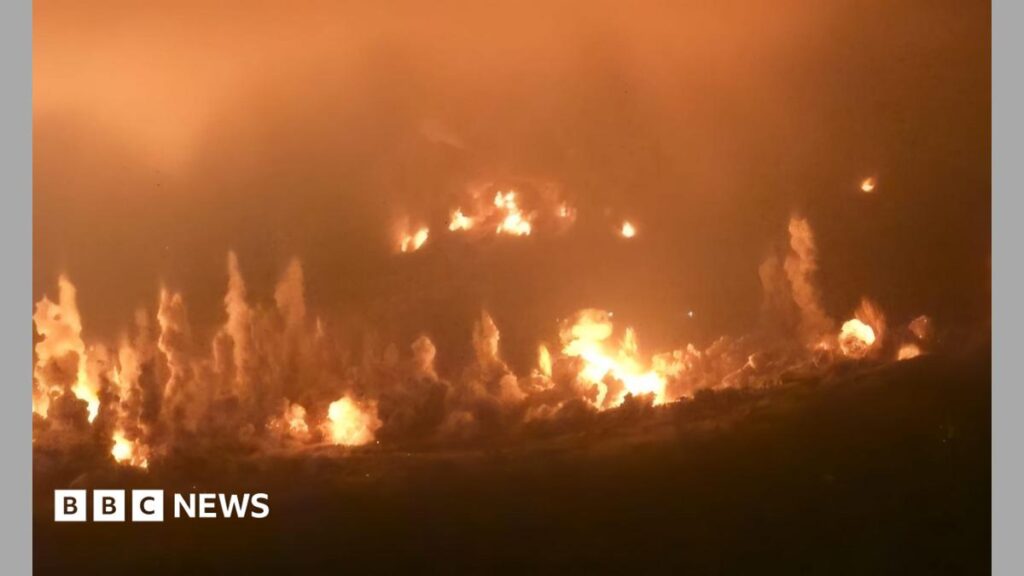
In the early hours of September 11, Israeli jets slammed a known Hezbollah site near the town of Marjayoun, a strategic hilltop that overlooks the Israeli‑Lebanese border. The United States Geological Survey recorded the resulting explosion as equivalent to a magnitude‑4.1 earthquake, a tremor strong enough to be felt in nearby villages and to shatter windows in the Israeli town of Metula.
Israel’s military spokesperson announced that the operation had destroyed a “major underground base” that housed a large stockpile of rockets, anti‑tank missiles and advanced communications equipment. According to the statement, the strike also collapsed several kilometers of tunnel, cutting off a critical supply line that Hezbollah had used to move materiel from Iran‑linked depots in Syria.
Lebanese authorities confirmed that the blast caused minor structural damage in the surrounding civilian area but reported no casualties. A local mayor, speaking to Al‑Jadeed, described the shaking as “like a small earthquake” and urged residents to stay clear of the site, which remains a contested zone between the two armies.
Why the underground base mattered to Israel
Hezbollah’s tunnel system is more than a storage facility; it is a strategic hedge against Israel’s air superiority. By burying rockets and launch platforms deep underground, the militia can conceal its firepower from satellite surveillance and launch surprise attacks from hidden positions. Analysts at the Institute for National Security Studies argue that the tunnels also enable rapid resupply from Iran‑backed convoys moving through Syria, a logistical lifeline that Israel seeks to sever.
Israeli intelligence assessments have repeatedly flagged the Marjayoun complex as a “launch node” capable of feeding rockets into the northern command zone within minutes of a flare‑up. The destruction of that node, therefore, is seen as a pre‑emptive move to blunt any imminent escalation and to send a clear message that Israel can still strike deep into Hezbollah’s defensive depth, despite the militia’s attempts to go further underground.
African stakes in the Israel‑Hezbollah showdown
Hezbollah’s financial engine is heavily intertwined with diaspora networks across West Africa, especially in Ghana, Nigeria and Côte d’Ivoire, where charitable fronts have been accused of funneling money to the Lebanese group. A 2024 report by the African Centre for the Study of Terrorism noted that a significant portion of Hezbollah’s funding comes from “informal value‑transfer systems” that move cash through African banks, a channel that could be disrupted if the group’s operational capacity is weakened.
Iran’s arms‑smuggling routes have long used the Red Sea corridor, with shipments passing through Sudan’s Darfur region and Libya’s coastal ports before reaching Hezbollah’s warehouses in Lebanon. The recent Israeli strike may force Iran and its proxies to reroute weapons through more distant pathways, potentially increasing the risk of illicit arms ending up in conflict zones such as the Sahel, where militant groups already benefit from a steady flow of small arms.
Beyond security, the blast reverberated through global oil markets. The heightened tension along the Israel‑Lebanon border raised concerns about a spill‑over into the Bab el‑Mandeb Strait, a chokepoint that handles roughly 20 percent of the world’s oil trade. Shipping analysts warned that any disruption could lift freight rates for African exporters, tightening the cost of moving cocoa, coffee and minerals to European markets.
What’s next? Diplomacy, deterrence and regional calculations
Israel is expected to monitor the aftermath of the strike closely and may launch follow‑up operations if intelligence indicates that Hezbollah has rebuilt the destroyed tunnels. Defence Minister Yoav Gallant has hinted that Israel will maintain a “relentless” campaign to degrade the militia’s underground capabilities, a stance that aligns with the broader Israeli doctrine of pre‑emptive deterrence.
Hezbollah, for its part, has vowed retaliation, with its leader Hassan Nasrallah likely to issue a televised address condemning the attack as a violation of Lebanese sovereignty. While the group has historically calibrated its response to avoid a full‑scale war, analysts caution that a series of high‑profile strikes could push it to fire a salvo of rockets into northern Israel, reigniting a broader conflict.
International actors are urging restraint. The United Nations Interim Force in Lebanon (UNIFIL) called for an immediate de‑escalation, while the United States and the European Union have offered diplomatic channels to prevent the incident from spiralling. African Union representatives, attending a summit in Addis Ababa, expressed concern over the potential impact on regional trade routes and called for a swift diplomatic resolution that safeguards the continent’s economic interests.
Quick Answers
What was the magnitude of the blast reported by the US Geological Survey?
The USGS measured the explosion as equivalent to a magnitude‑4.1 earthquake.
Where was the Hezbollah underground base that Israel said it destroyed?
The base was located near the town of Marjayoun in southern Lebanon, close to the Israeli‑Lebanese border.
How could the strike affect African markets or security?
Disruption of Hezbollah’s funding and Iran’s arms routes may alter illicit money flows and weapons smuggling through West Africa, while heightened tension in the Red Sea could raise freight costs for African exporters.
Source: www.bbc.co.uk




💬 Comments 0