Jordan church funeral shooting kills 7, wounds 34 in Karak governorate – 2026 attack sparks security concerns
Background: A fragile peace in Jordan’s Christian community
Jordan’s Christian minority, estimated at about 2‑3 percent of the population, has traditionally enjoyed a degree of religious freedom uncommon in the region. The country’s constitution guarantees worship rights, and Christians have historically held seats in parliament and served in the security forces. Yet the community remains vulnerable, especially in the southern governorates where sectarian tensions can flare amid broader regional instability.
The town of Al‑Karak, a historic city near the Saudi border, hosts several churches that draw worshippers from surrounding villages. Over the past decade, the area has seen a modest influx of Syrian and Iraqi refugees, many of whom are also Christian, adding to the demographic mix. While the Jordanian authorities have maintained tight security, occasional spill‑over attacks from extremist cells have raised alarm among local leaders.
In recent months, Jordan has stepped up counter‑terrorism operations after a series of low‑level bombings in Amman and a failed plot against a foreign embassy. The security services have warned that radical groups are seeking to exploit sectarian fault lines, targeting gatherings that guarantee a high civilian presence, such as weddings, funerals, and religious services.
The attack: Seven dead and dozens injured at a funeral service
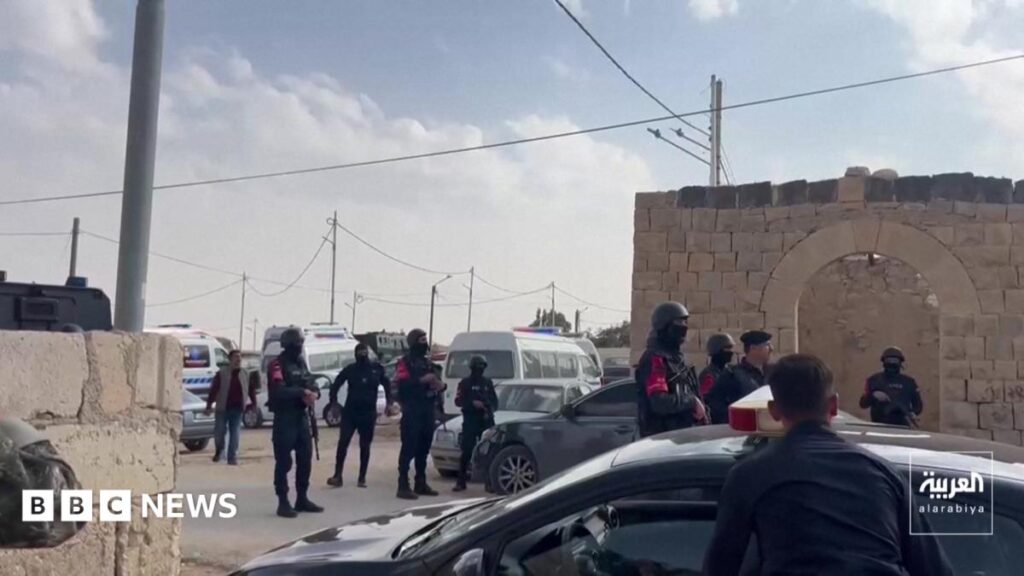
On the evening of 22 October 2026, gunmen opened fire on a funeral service held at St. George’s Orthodox Church in the town of Al‑Karak. According to officials, at least seven worshippers were killed on the spot and 34 others suffered gunshot wounds ranging from superficial to critical. The assailants fled in a white van, prompting an immediate lockdown of the surrounding neighborhoods.
Emergency responders arrived within minutes, transporting the injured to King Hussein Medical Center, where surgeons worked through the night to stabilize the victims. Local police cordoned off the area, collected shell casings, and launched a manhunt that has already resulted in the detention of two suspects, though their identities and motives remain unclear.
Jordan’s Interior Minister, Sameer Mubaidin, condemned the act as “an affront to the values of coexistence that Jordan upholds.” He announced a special investigative commission and promised that the perpetrators would face “the full weight of the law.” The ministry also warned of a possible escalation if the attack is linked to trans‑national terrorist networks.
Why it matters: Security, sectarian harmony and regional optics
The shooting strikes at the heart of Jordan’s narrative of religious tolerance, a cornerstone of its soft‑power diplomacy. International donors, including the United States and European Union, regularly cite Jordan’s protection of minorities as a justification for aid packages that fund refugee camps, health services, and education programs. A high‑profile attack on a Christian funeral threatens to erode that narrative and could invite stricter scrutiny of Jordan’s security apparatus.
From a security standpoint, the incident may signal a shift in tactics by extremist cells operating in the Arabian Peninsula. Targeting a funeral maximises casualties while sending a symbolic message to both the Christian minority and the broader population. If the attackers are linked to the Islamic State’s “Wilayat Sinai” or to a local offshoot, it would indicate that Jordan is no longer a peripheral theater but a potential frontline in the fight against jihadist resurgence.
The attack also carries diplomatic weight. Jordan’s monarchy has long acted as a mediator in Israeli‑Palestinian talks and as a stabilising force in the Israeli‑Lebanese border. Any perception that the state cannot protect its own citizens could weaken its leverage in regional negotiations, especially as neighboring countries grapple with their own sectarian unrest.
African refugees and diaspora: A hidden ripple effect
Jordan hosts roughly 100,000 refugees from Sudan, South Sudan, and Ethiopia, many of whom live in camps near the southern governorates. While the victims of the Karak shooting were predominantly Jordanian Christians, the incident has heightened anxiety among African migrants who already feel precarious in a country where they face occasional discrimination and limited legal pathways to work.
Human‑rights NGOs, such as the African Diaspora Forum in Amman, have warned that the attack could fuel xenophobic rhetoric, especially if political actors attempt to scapegoat foreign nationals for security lapses. In the past, similar incidents in the Middle East have led to tightened curfews and increased police checkpoints that disproportionately affect African communities, restricting their movement and access to humanitarian aid.
Moreover, the incident may disrupt the delivery of aid to refugee camps that rely on Jordanian logistics hubs. International NGOs often coordinate shipments through Karak’s transport corridors; a security clamp‑down could delay food, medical supplies, and cash assistance, exacerbating already fragile conditions for Sudanese families fleeing conflict in Darfur.
What’s next: Investigations, policy shifts and regional cooperation
The immediate priority for Jordanian authorities is to identify the gunmen and dismantle any network behind the attack. Sources close to the interior ministry say that security forces are reviewing intelligence from neighboring Saudi Arabia and Iraq, where several extremist cells have recently resurfaced. A joint task force may be formed to monitor cross‑border movements of weapons and militants.
Domestically, the government is expected to tighten security around places of worship, a move that could include mandatory CCTV installations and increased police patrols during religious gatherings. While such measures may deter future attacks, they also raise concerns about civil liberties and the potential stigmatization of minority communities.
On the diplomatic front, Jordan is likely to seek renewed support from its Western allies for counter‑terrorism funding, while also reaching out to Gulf states for intelligence sharing. The incident could also prompt a renewed dialogue with the Vatican and the World Council of Churches, as Jordan looks to reaffirm its commitment to protecting Christian sites and to counter the narrative that the country is slipping into sectarian violence.
Quick Answers
Who were the victims of the Karak church funeral shooting?
The victims were mainly Jordanian Christians attending a funeral at St. George’s Orthodox Church; seven were killed and 34 injured.
How might the attack affect African refugees living in Jordan?
Increased security measures could restrict movement for Sudanese and Ethiopian refugees, and heightened tensions may fuel xenophobic rhetoric against African migrants.
What steps is the Jordanian government taking after the shooting?
Authorities have launched a manhunt, detained two suspects, formed a special investigative commission, and announced plans to boost security around religious sites.
Source: www.bbc.co.uk



💬 Comments 0