Marseille unrest: Over 200 arrests as protests turn apocalyptic in France’s second city
Background – Marseille’s volatile mix of history and demographics
Marseille has long been a flashpoint for social tension in France. The port city, the country’s second‑largest, hosts a mosaic of communities, with people of North‑African descent accounting for roughly a third of its population, according to the latest INSEE data.
Economic disparities run deep: unemployment in the city’s northern districts hovers above 15%, far higher than the national average. This structural inequality has repeatedly fed into street protests, from the 2005 riots to the 2023 “Yellow Vests” demonstrations that spilled over into the harbor.
The city’s relationship with the French state is also shaped by a legacy of policing controversies. Several high‑profile incidents involving the national police have left lasting scars, especially among young men of Maghrebi heritage who feel targeted by security forces.
The flashpoint – What sparked the latest wave of disorder
On Saturday, a municipal decision to ban the public display of certain religious symbols in schools triggered an immediate outcry. Activists argued the rule singled out Muslim girls wearing hijabs, a community that already feels marginalized in public life.
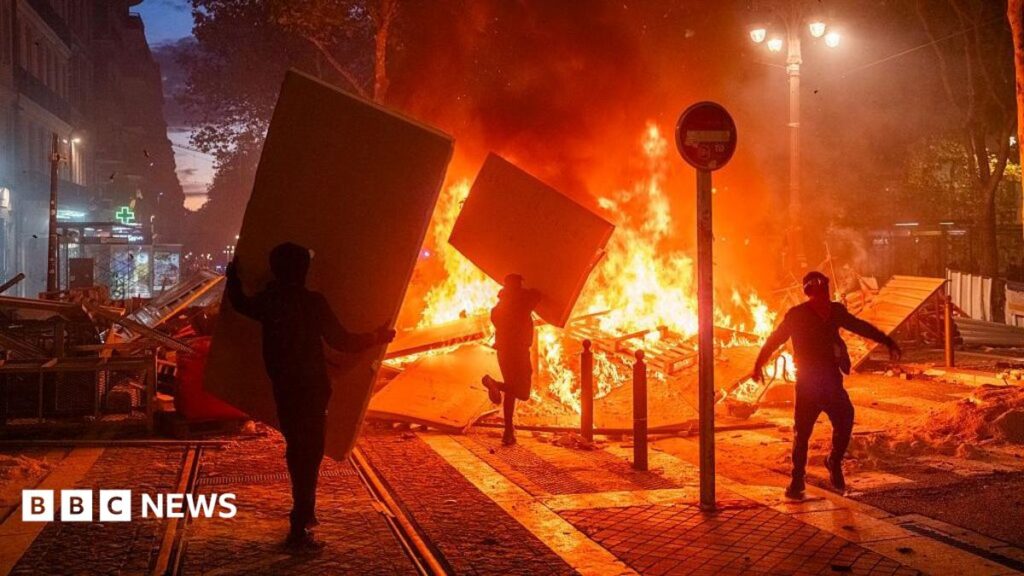
Protesters gathered at the historic Vieux‑Port, but the crowd quickly turned confrontational when police attempted to disperse the march with tear‑gas canisters. Video footage shared on social media showed storefronts smashed, cars set ablaze, and a makeshift barricade erected from overturned buses.
According to Le Figaro, more than 200 people were arrested within the first three hours, and dozens of police officers required reinforcement from the national gendarmerie. The chaos was described by on‑the‑ground witnesses as “apocalyptic” because of the sheer scale of the destruction.
Why it matters – Political, security and diaspora implications
The unrest puts the French government under renewed pressure to balance security with civil liberties. President Léa Martin’s administration, still navigating the fallout from the 2024 pension reform protests, now faces criticism from both the far‑right, which calls for harsher crackdowns, and left‑wing parties demanding deeper social investment.
For the African and Arab diaspora in France, the events raise concerns about a possible escalation of identity‑based policing. Community leaders fear that the narrative of “law‑and‑order” could be weaponised to justify broader surveillance of neighbourhoods where many immigrants live.
Beyond France, the turmoil reverberates across the Maghreb. Governments in Algeria and Morocco monitor the situation closely, as any perception of French hostility toward Muslim symbols can fuel anti‑French sentiment and affect bilateral trade, especially in the energy sector where French firms hold significant stakes.
Connecting the dots – A pattern of unrest in French cities with large North‑African populations
Marseille is not an isolated case. In the past two years, similar flare‑ups have erupted in Lyon, Lille and Nice, each time following policies that touch on secularism or policing. A 2025 study by the French Institute of Public Affairs linked the frequency of riots to the concentration of residents of Maghrebi origin in disadvantaged districts.
These incidents underline a broader trend: the French republican model of universalism is increasingly at odds with the lived realities of multicultural suburbs. When legislation is perceived as targeting specific cultural practices, it can ignite the same kind of street backlash that authorities witnessed in Marseille.
The pattern also reveals a feedback loop. Heavy police presence after an outbreak often fuels feelings of alienation, which in turn makes future protests more volatile. Scholars such as Dr. Aïcha Ben‑Mansour (Université de Paris‑Sorbonne) argue that without targeted socioeconomic programmes, the cycle of unrest is likely to repeat.
What’s next – Potential policy routes and community responses
The government has signalled a two‑pronged approach: a short‑term increase in police resources for Marseille, and a longer‑term commission to review secular‑school policies. Sources close to the interior ministry say the commission will include representatives from Muslim NGOs, a move meant to defuse accusations of unilateral decision‑making.
Local activists are organising “peace corridors” in the city’s northern quarters, where community mediators will work with police to de‑escalate tensions. Similar initiatives in Tunis and Casablanca have shown promise in preventing small skirmishes from spiralling into full‑scale riots.
For African investors watching the French market, the unrest is a reminder of political risk. The French stock index dipped 1.2% on the day of the protests, and analysts at Africa‑Europe Capital advise a cautious stance on French energy and transport stocks until stability is restored.
Quick Answers
How many people were arrested during the Marseille protests?
More than 200 arrests were reported within the first three hours of the unrest, according to French media outlets.
Why did the protests in Marseille turn violent?
The violence erupted after a municipal ban on public display of certain religious symbols in schools, which many saw as targeting Muslim hijabs, sparking confrontations with police.
What impact could the unrest have on French‑African trade?
Heightened tensions may strain diplomatic ties and affect French energy and transport companies operating in North Africa, prompting investors to reassess exposure.
Source: www.bbc.co.uk



💬 Comments 0