Poland police stand‑off over Supreme Court control after suspension of two justices, 2026
Background: a decade of judicial overhauls
Since 2015 the Law and Justice (PiS) party has reshaped Poland’s courts, arguing that the pre‑2005 system was a holdover of communist‑era control. Reforms introduced a new appointment process for judges, lowered the retirement age and gave the Ministry of Justice the power to dismiss senior magistrates. Critics, including the European Commission, say the changes undermine judicial independence and breach EU standards on the rule of law.
The Constitutional Tribunal, Poland’s top constitutional court, became the flashpoint of the dispute. In 2022 the government passed a law allowing it to appoint five of the fifteen judges, effectively giving PiS a majority. The move sparked protests, lawsuits at the European Court of Justice, and a series of funding freezes on projects linked to the rule‑of‑law clause in the EU budget.
The stand‑off: police, suspensions and criminal charges
In early October 2026 the Ministry of Justice announced the suspension of two senior judges of the Constitutional Tribunal, citing alleged misconduct and breach of confidentiality. Within days the government filed criminal complaints accusing the justices of leaking classified deliberations. The two judges, both appointed before the 2022 reforms, refused to step down, prompting a standoff at the court’s headquarters in Warsaw.
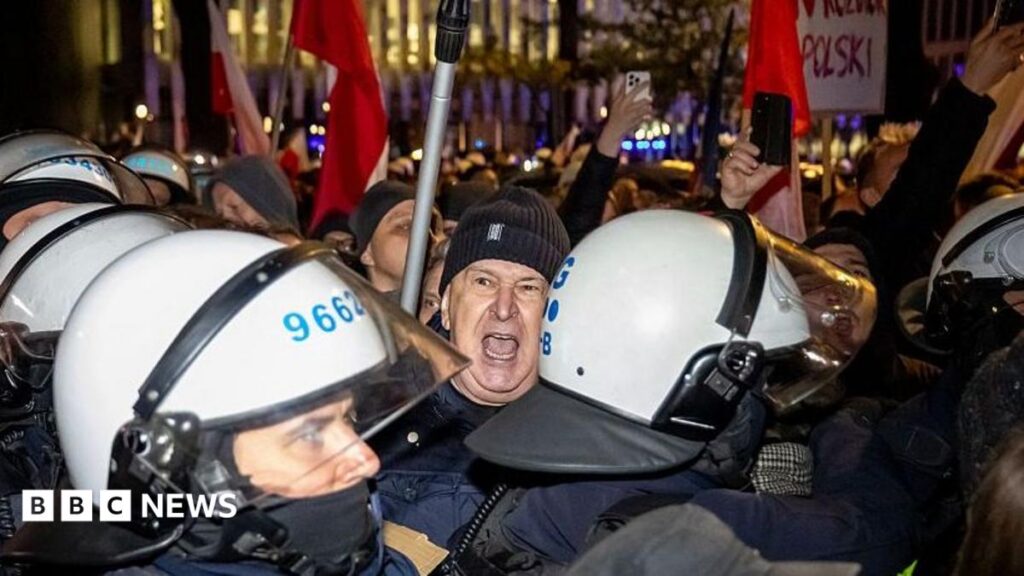
Police units equipped with riot gear were deployed to the building on October 28, forming a perimeter and preventing supporters from entering. The force was meant to “maintain public order,” according to a statement from the Interior Ministry, but opposition leaders described the presence of officers as an intimidation tactic. The standoff lasted three days, during which the justices held a press conference from inside the court, insisting that the charges were politically motivated.
Why it matters for Europe: rule‑of‑law funding and political stability
Poland is the EU’s second‑largest net contributor to the bloc’s budget, and its compliance with rule‑of‑law criteria determines eligibility for cohesion funds, research grants and the new €1.8 trillion climate budget. The European Commission has already threatened to withhold up to €7 billion in funds if Poland does not reverse the judicial reforms, according to a March 2026 report.
The current crisis could tilt the balance in the upcoming European Parliament elections. Parties that champion democratic norms, such as the European People’s Party, are positioning the Poland case as a test of the EU’s ability to enforce its own standards. A prolonged deadlock may embolden other member states with illiberal tendencies, weakening the Union’s collective bargaining power on the global stage.
Ripple effects for Africa: EU aid, climate finance and trade links
The EU’s rule‑of‑law conditionality does not stop at its borders. A significant portion of the Union’s development assistance to African countries is tied to the same budget that could be frozen for Poland. According to the European External Action Service, about €12 billion of the 2024‑2027 EU‑Africa partnership is earmarked for climate resilience, infrastructure and governance projects.
If the EU decides to withhold funds from Poland, the shortfall will be redistributed across the remaining member states, potentially reducing the pool available for Africa. African NGOs and civil‑society groups have warned that any dip in funding could delay critical projects, from renewable‑energy installations in Kenya to water‑security programmes in Nigeria. Moreover, the dispute highlights a broader concern among African leaders: the reliability of European financing when internal politics interfere with external commitments.
What’s next: scenarios, EU response and diaspora implications
Experts outline three likely paths. First, the government could drop the criminal case and negotiate a settlement, allowing the judges to retire voluntarily. Second, the European Court of Justice may issue an interim order forcing Poland to suspend the charges, a move that would test the EU’s enforcement mechanisms. Third, the standoff could escalate into a broader constitutional crisis, prompting early elections or a vote of no confidence in the PiS cabinet.
For the Polish diaspora in Africa—particularly the small but growing community of business professionals in South Africa and Kenya—the outcome matters for mobility and investment. A stable, EU‑compliant Poland is expected to maintain its bilateral agreements on tax treaties and double‑taxation avoidance, which facilitate cross‑border ventures. Uncertainty, however, could deter Polish investors from expanding into African markets, a trend the Ministry of Development has been courting since 2023.
Quick Answers
Why did the Polish government suspend two Constitutional Tribunal judges in 2026?
The ministry cited alleged misconduct and the leaking of confidential deliberations, but opposition parties say the moves are politically motivated to consolidate control over the court.
How could Poland’s judicial crisis affect EU funding for African projects?
If the EU withholds Poland’s share of the budget due to rule‑of‑law breaches, the total amount available for Africa‑focused programs could shrink, delaying climate and infrastructure initiatives.
What are the possible outcomes of the stand‑off at Poland’s top court?
Options include a negotiated settlement, an EU Court of Justice order forcing a pause on the charges, or a deeper constitutional crisis that may trigger early elections.
Source: www.bbc.co.uk




💬 Comments 0