Russia hits Ukrainian train on Polish border after Boris Johnson leaves station – Sept 14 2026
Background: Russia’s escalation on the Ukrainian front
Since the start of the conflict in 2022, Moscow has repeatedly targeted Ukraine’s rail network, a lifeline for civilian supplies and military logistics. By 2026, the pattern has shifted from large‑scale missile strikes on major hubs to more precise attacks on smaller, often stationary assets, a tactic designed to sow uncertainty and stretch Ukrainian defensive resources.
The winter of 2025‑2026 saw a spike in cross‑border incidents, especially along the Polish‑Ukrainian frontier, where both nations have bolstered border security after a series of smuggling and infiltration attempts. NATO’s eastern flank has been on high alert, and Poland has hosted several joint exercises with U.S. and European forces to deter further aggression.
Western leaders have condemned the attacks as violations of international humanitarian law, but diplomatic progress has stalled. The latest round of peace talks in Geneva ended without a breakthrough, leaving the battlefield in eastern Ukraine and the surrounding border regions as the primary arena for Russian pressure tactics.
The attack on the stationary locomotive
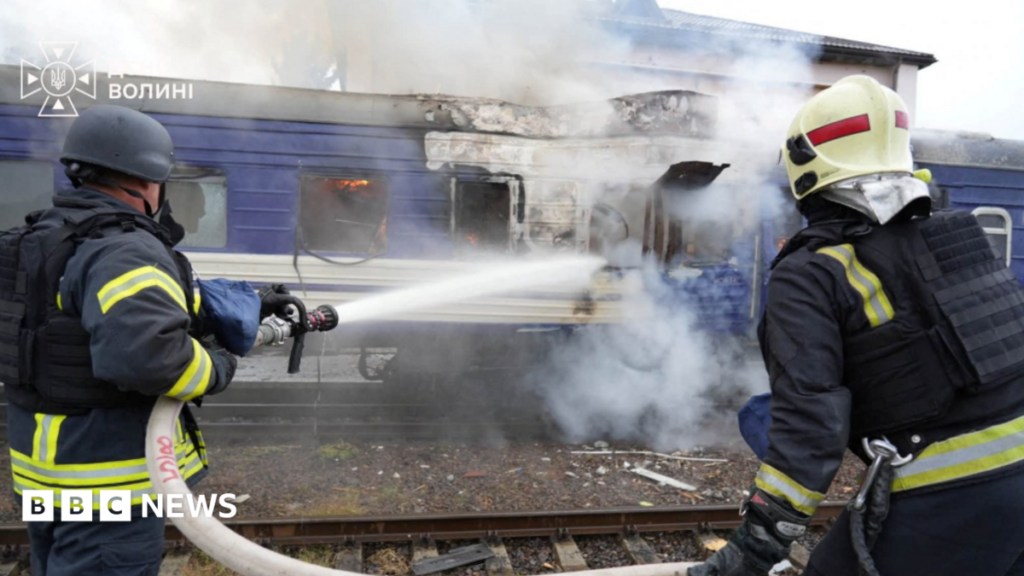
In the early hours of September 14, a Russian artillery strike hit a Ukrainian freight train that was parked near the border town of Medyka, a short distance from the Polish side. The locomotive, unmoving and reportedly empty of cargo, was struck by a precision‑guided shell that caused a fire but no casualties, according to Ukrainian rail officials.
The strike occurred just minutes after former British prime minister Boris Johnson, alongside senior European officials, stepped off a train at the same station. Johnson later described the incident as “a shocking act of war against a stationary target,” and expressed bewilderment at what he called “warped logic” behind the decision, as reported by the BBC.
Ukrainian authorities quickly labeled the attack a violation of the cease‑fire agreements that govern cross‑border engagements. They also warned that the incident could trigger a broader escalation, especially if NATO members interpret the strike as a direct threat to the security of neighboring allies.
Why the timing matters: diplomatic fallout
The proximity of the attack to Johnson’s departure has amplified the diplomatic fallout. While the former prime minister was in the region on a fact‑finding mission aimed at rallying European support for Ukraine’s reconstruction, the strike underscores how quickly the battlefield can intersect with high‑level diplomacy.
Analysts in Brussels suggest that the timing may be a calculated signal from Moscow, intended to demonstrate that even symbolic gestures of solidarity will not shield Ukrainian infrastructure from attack. According to a senior European security official speaking on condition of anonymity, the move could be an attempt to “test the resolve of Western leaders after they have left the immediate scene.”
The incident is likely to feed into ongoing debates within NATO about the rules of engagement on the alliance’s eastern border. Some member states have already called for a reassessment of air‑defence deployments in Poland, while others urge restraint to avoid a direct clash with Russian forces.
Implications for Europe and African interests
Beyond the immediate European security concerns, the strike has ripple effects for African markets that rely on Ukrainian grain exports. Ukraine supplies roughly 12 % of Africa’s wheat imports, and any disruption to rail logistics can delay shipments destined for North Africa and the Horn of Africa, where food security remains fragile.
Several African nations, including Nigeria and Kenya, have recently joined the G20’s call for a “humanitarian corridor” to keep grain flowing despite the war. The latest attack threatens to undermine those diplomatic efforts, prompting African foreign ministries to urge the UN Security Council to intensify pressure on Moscow for a cease‑fire on transport routes.
The incident also resonates with the African diaspora in Europe, many of whom work in logistics and rail sectors across the continent. Community leaders in cities like London, Paris, and Brussels have expressed solidarity with Ukrainian workers while warning that heightened tensions could lead to stricter border controls that affect migrant labor mobility.
What comes next: diplomatic and security outlook
In the short term, Ukraine is expected to request additional air‑defence assets from NATO allies to protect vulnerable rail lines near the Polish border. The United States has indicated willingness to accelerate the delivery of Patriot batteries, a move that could deter further artillery strikes but also risk provoking a Russian response.
Long‑term, the episode may force a recalibration of the peace‑process timeline. If European leaders interpret the attack as a direct challenge, they may push for more punitive sanctions, while Russia could double down on targeting infrastructure to extract political concessions. Observers note that the next diplomatic round in Geneva, slated for late October, will likely address rail security as a prerequisite for any meaningful dialogue.
Quick Answers
Did Russia target a civilian train on September 14, 2026?
Yes, Russian artillery struck a stationary Ukrainian freight locomotive near the Polish border on that date.
How could the attack affect African grain imports?
Disruption of Ukrainian rail routes can delay wheat shipments that supply about 12 % of Africa’s grain needs, raising food‑security concerns.
What response is expected from NATO after the strike?
NATO is likely to consider bolstering air‑defence in Poland and may accelerate delivery of Patriot systems to Ukraine.
Source: www.bbc.co.uk



💬 Comments 0