Trump rules out joint US‑China AI venture in 2026, citing growth concerns
Background: The US‑China AI tug‑of‑war
Artificial intelligence has become the newest frontier of strategic competition between Washington and Beijing, with both powers racing to dominate foundational models, chips, and data ecosystems. Over the past decade, the two economies have alternated between limited cooperation on standards and fierce rivalry over talent and export controls.
President Donald Trump, who returned to office in 2025, has repeatedly framed technology policy as a matter of national prosperity rather than security, arguing that excessive regulation could choke innovation. His administration has therefore resisted calls from Congress and some allies to impose strict guardrails on AI development.
In early 2026, several think‑tanks and industry groups floated the idea of a joint US‑China research hub to pool resources on safe AI, hoping to defuse tensions and set global norms. The proposal sparked a brief wave of optimism among technologists who feared a bifurcated AI world.
The decision: Trump rules out a joint venture
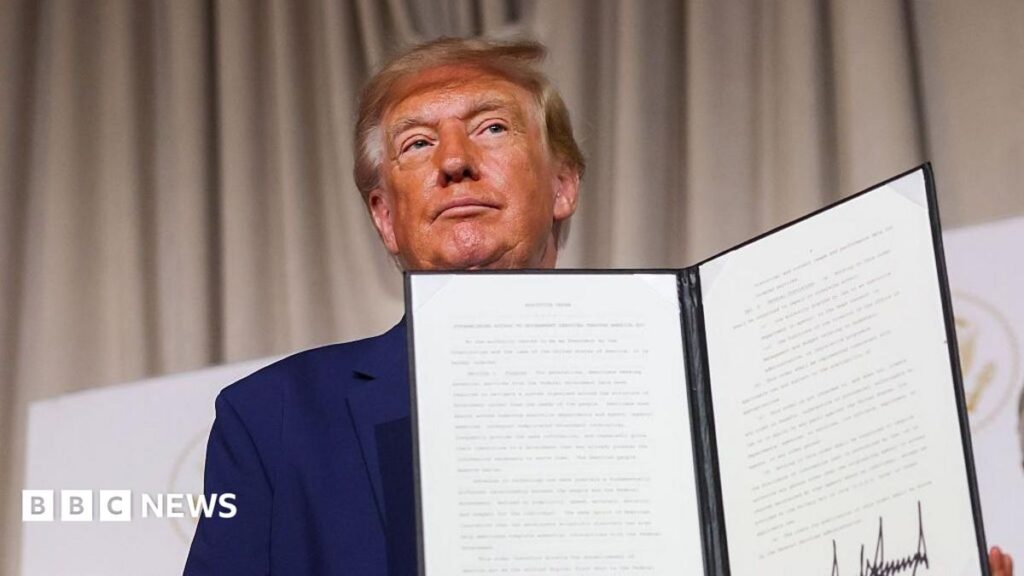
At a press conference on September 30, 2026, Trump announced that the United States would not pursue a joint AI venture with China, describing the plan as “a distraction that would slow our own growth.” He emphasized that the private sector should lead, and that government‑mandated collaboration would “hand over our competitive edge.”
The president’s remarks were echoed in a White House statement that cited “the need to protect American intellectual property and to keep the innovation pipeline flowing without foreign interference.” No formal request for a joint venture had been filed, but the announcement effectively shut down any pending discussions within the State Department and the Commerce Department.
Industry insiders reported that the decision was influenced by recent congressional hearings on AI security, where several lawmakers warned that joint research could give Beijing access to cutting‑edge models that could be weaponized. Sources say the administration also weighed the political cost of appearing soft on China ahead of the mid‑term elections.
Why it matters: Tech sovereignty and the global AI race
By rejecting a joint venture, the United States signals a firm commitment to technological sovereignty, a stance that could accelerate the fragmentation of AI standards. Analysts warn that a split could force companies to develop separate versions of software for the US and Chinese markets, raising costs and slowing cross‑border innovation.
The move also reshapes the broader AI arms race, where Europe, Japan, and India are watching closely to see whether the two superpowers will cooperate or continue to compete. If the US leans fully into a unilateral approach, Beijing may double down on its own state‑backed AI programs, potentially widening the gap in areas like quantum‑ready algorithms and autonomous weapons.
Investors have already reacted, with US AI‑focused venture funds pulling back from deals that involve Chinese co‑founders. According to Bloomberg, capital allocated to cross‑border AI startups fell by roughly 15 % in the quarter following Trump’s announcement.
African angle: AI hopes, Chinese capital, and US policy spill‑over
African tech hubs such as Nairobi’s “Silicon Savannah” and Lagos’s burgeoning AI community have been courting both US and Chinese investors to accelerate home‑grown solutions for agriculture, health, and finance. China’s Belt‑and‑Road AI labs have funded several African startups, offering access to low‑cost cloud compute and data‑labeling services.
Trump’s stance may indirectly affect those partnerships. If US firms become wary of any Chinese linkage, they could retreat from joint projects that involve Chinese data pipelines, leaving African startups with fewer financing options. Conversely, a clear US‑China split could make Chinese AI firms more eager to fill the financing vacuum, deepening Beijing’s foothold on the continent.
Policy experts in Africa note that the decision underscores the importance of building indigenous AI capacity. “Relying on external superpowers for AI talent is risky,” says Dr. Aisha Bello, a Nairobi‑based AI policy researcher. “Continental initiatives like the African Union’s AI Strategy become even more critical now.”
Reactions: Industry, lawmakers, and African stakeholders
Tech giants such as Microsoft and Nvidia welcomed the president’s clarification, arguing that private‑sector collaboration should remain voluntary and market‑driven. In a brief statement, Microsoft’s Azure AI head said, “We will continue to work with partners worldwide, but any government‑mandated joint venture would be counter‑productive.”
Several Democratic senators, however, criticized the move as short‑sighted. Senator Maria Cortez (D‑CA) told reporters that “the United States cannot afford to ignore the diplomatic value of joint research when the stakes are as high as AI safety.” She called for a bipartisan AI oversight bill that would create an independent advisory board.
African diaspora tech entrepreneurs expressed mixed feelings on social media. While some praised the emphasis on domestic growth, others warned that the US’s retreat could push African innovators toward Chinese platforms that have fewer data‑privacy safeguards. A Lagos‑based startup founder posted, “We need clear rules, not a tug‑of‑war that leaves us in the middle.”
What’s next: Alternative pathways and policy outlook
With the joint venture off the table, the White House is likely to double down on export‑control measures that limit the transfer of advanced AI chips to China, a policy already in motion under the Export Control Reform Act. Industry groups are lobbying for clearer guidelines that would allow non‑sensitive research to continue without triggering licensing hurdles.
In Africa, governments are expected to accelerate their own AI roadmaps. The African Development Bank announced a $500 million fund in October 2026 aimed at supporting AI projects that address climate resilience and health security, explicitly positioning the fund as an alternative to both US and Chinese capital streams.
Long‑term, the AI landscape may settle into a multipolar configuration, where regional blocs develop interoperable standards. Observers note that such a scenario could benefit African nations that are not tied to any single superpower’s ecosystem, allowing them to pick the best tools from each side while maintaining data sovereignty.
Quick Answers
Why did President Trump reject a joint US‑China AI venture?
He argued that a joint effort would slow American growth and risk exposing U.S. intellectual property to China.
How could the decision affect African AI startups?
It may limit U.S. funding for projects linked to China, pushing African startups toward Chinese investors or prompting them to seek independent African financing.
What are the next steps for U.S. AI policy after the announcement?
The administration is expected to tighten export controls on advanced AI chips and encourage private‑sector collaboration without government‑mandated joint ventures.
Source: www.bbc.co.uk




💬 Comments 0