ESA’s Hera spacecraft reaches Dimorphos in 2026 to assess DART impact damage
Background: DART’s historic impact on Dimorphos
In September 2022 NASA’s Double Asteroid Redirection Test (DART) deliberately slammed into Dimorphos, the moon of the near‑Earth asteroid Didymos, to see if a kinetic impact could nudge an asteroid off a collision course. The impact shaved about 10 seconds off Dimorphos’s 11‑hour orbital period, confirming that a spacecraft can alter an asteroid’s trajectory in a measurable way.
The experiment was a first‑of‑its‑kind planetary‑defence test, designed to give humanity a playbook for a future threat. While the immediate result was a scientific triumph, many questions remained about the crater’s size, the amount of material ejected, and how the impact reshaped the binary system’s dynamics.
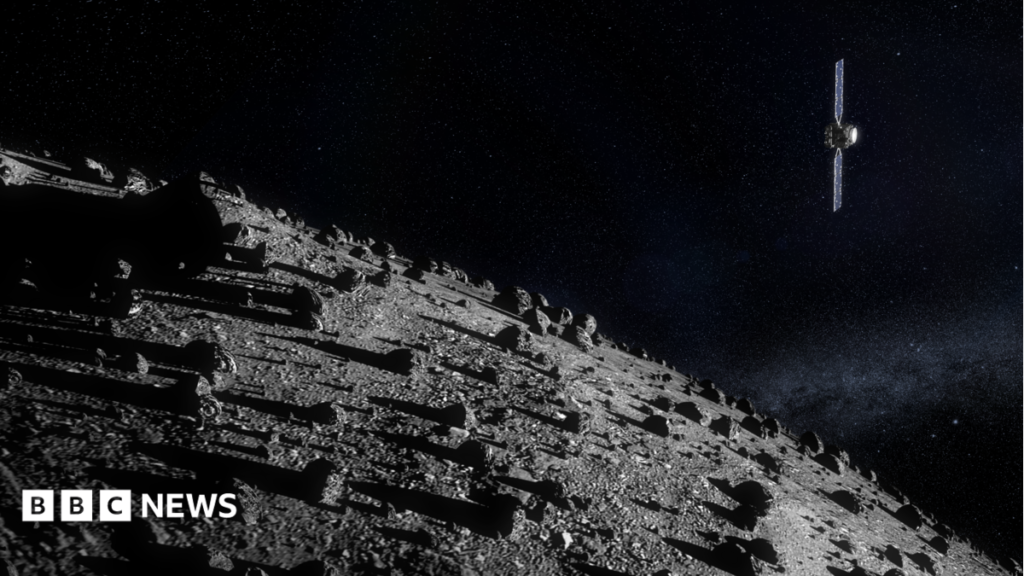
Four years later, the European Space Agency’s (ESA) Hera mission has finally arrived at the Didymos system, bringing high‑resolution cameras, a lidar scanner, and a small impactor of its own to answer those lingering questions.
The Hera mission arrives: what the spacecraft will do
Hera launched in October 2024 on an Ariane 6 rocket and spent roughly two years cruising to the asteroid pair, using solar electric propulsion to fine‑tune its trajectory. In early 2026 it entered orbit around Didymos and began a series of close‑flybys of Dimorphos, mapping the crater left by DART with centimetre‑scale precision.
Among Hera’s payload is the CubeSat Milani, a tiny impactor that will create a secondary crater. By comparing the two craters, scientists can infer how different impact energies and angles affect asteroid material, data that is crucial for designing future deflection missions with varying budgets and timelines.
The mission also carries a suite of spectrometers that will analyse the composition of the asteroid’s surface. Understanding the mineralogy helps refine models of how momentum is transferred during an impact, a factor that varies dramatically between rocky, metallic, or loosely‑bound “rubble‑pile” asteroids.
Why planetary defence matters for Africa
Africa is not immune to the rare but catastrophic scenario of an asteroid strike. A 2021 study by the International Astronomical Union estimated that a 100‑metre object could cause regional devastation, and the continent’s densely populated coastal cities—Lagos, Alexandria, Durban—would be especially vulnerable.
Many African nations lack dedicated planetary‑defence programmes, relying instead on data shared by NASA, ESA, and other space agencies. The Hera results will be openly published, giving African researchers the raw measurements they need to model impact scenarios for their own regions and to lobby for inclusion in global early‑warning networks.
In addition, the African Union’s Space Programme, launched in 2023, has earmarked planetary‑defence as a strategic priority. The agency plans to set up a continental centre for Near‑Earth Object (NEO) monitoring by 2028, and Hera’s findings will shape the technical specifications of the sensors and algorithms that will be deployed.
Economic and scientific ripple effects across the continent
The asteroid‑defence field is spawning a new market for space‑technology components—high‑precision navigation chips, radiation‑hardening materials, and autonomous docking systems. Companies in South Africa’s Cape Town Tech Hub and Kenya’s Nairobi Silicon Savannah have already begun prototyping parts that could be used in future deflection missions.
Universities in Nigeria, Egypt, and Ghana are integrating Hera data into their astrophysics curricula, giving students hands‑on experience with real‑world measurements. This is expected to boost the talent pool for Africa’s nascent space industry and could attract foreign investment into local research labs.
Beyond defence, the mission’s mineral‑composition data revives interest in asteroid mining. If Dimorphos contains water‑rich minerals, it could serve as a proof‑of‑concept for extracting resources that support deep‑space habitats—an industry that African entrepreneurs are watching closely as part of long‑term economic diversification.
Looking ahead: next steps in asteroid mitigation
The immediate next step after Hera’s primary survey is a joint ESA‑NASA workshop slated for late 2026, where scientists will compare DART’s kinetic‑impact data with Hera’s crater measurements. The goal is to refine the “momentum‑transfer efficiency” factor that underpins all future deflection calculations.
Long‑term, the data will feed into the design of a follow‑up mission, possibly a larger impactor or a gravity‑tractor spacecraft, that could be launched within the next decade. African space agencies have expressed interest in contributing instrumentation or ground‑station support, turning the continent from a passive data recipient into an active participant.
Finally, the public outreach component of Hera is expected to inspire a new generation of African engineers. ESA’s “Asteroid Watch” programme already runs school‑level contests in Kenya and Tanzania, and the live‑streamed fly‑bys will give students a front‑row seat to a historic moment in planetary defence.
Quick Answers
What is the purpose of ESA’s Hera spacecraft?
Hera’s mission is to map the crater DART created on Dimorphos, study the asteroid’s composition, and test a secondary impact to improve asteroid‑deflection models.
When did Hera reach the Didymos system?
Hera entered orbit around Didymos in early 2026, four years after DART’s impact.
How does the DART‑Hera mission affect Africa?
The data will help African scientists build regional impact‑risk models, support the continent’s new planetary‑defence initiatives, and spur local space‑tech businesses.
Source: www.bbc.co.uk




💬 Comments 0