Imran Khan supporters march on Islamabad after deadlocked talks, 2026 protests
Background: Khan’s fall from power and his imprisonment
Imran Khan, the charismatic former prime minister of Pakistan, was ousted in a parliamentary vote of no confidence in April 2022 and later convicted on corruption charges that landed him in jail in early 2026. His removal sparked a wave of protests across the country, with his Pakistan Tehreek-e-Insaf (PTI) party claiming the legal process was politically motivated. Over the past year, the PTI has organised rallies, sit‑ins and legal challenges, positioning Khan as a symbol of anti‑establishment sentiment.
The political landscape in Pakistan has grown increasingly volatile. The current coalition government, led by Prime Minister Shehbaz Sharif, has struggled to maintain parliamentary majorities while facing a crumbling economy and rising inflation. International observers, including the International Crisis Group, have warned that the deadlock between the state and Khan’s supporters could destabilise the country ahead of the scheduled general elections in early 2027.
The march: thousands converge on the capital
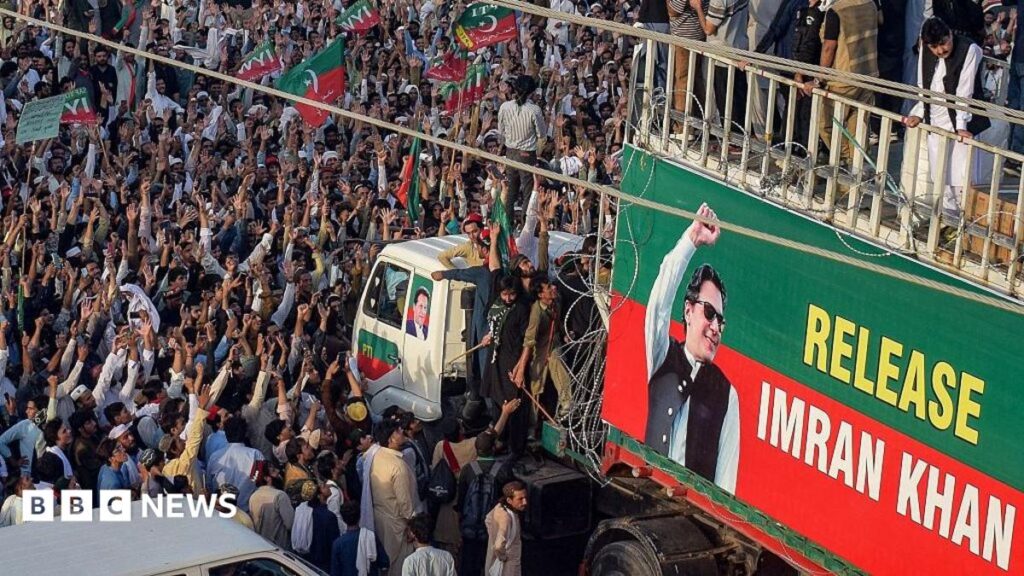
On October 5, 2026, an estimated 15,000 to 20,000 PTI supporters gathered at the historic Liaquat Bagh before marching toward Islamabad’s Red Zone. The demonstrators carried placards demanding Khan’s release, an end to what they called “political victimisation”, and fresh elections. Police deployed water cannons and tear‑gas shells in several choke points, but the crowd largely remained peaceful, chanting slogans and chanting the PTI anthem.
The rally came after a series of secret talks between senior PTI negotiators and senior officials from the Ministry of Interior failed to produce a compromise. Sources close to the negotiations, speaking to Reuters on condition of anonymity, said the deadlock centred on whether Khan would be granted a conditional bail that would limit his political activity. When the talks stalled, PTI activists decided to take their grievances to the streets, hoping to force the government’s hand.
Why it matters: domestic stability and the economy
The protest underscores a deeper crisis of legitimacy for Pakistan’s ruling coalition. With inflation still hovering above 30 % and the national currency, the rupee, losing more than 20 % of its value against the dollar this year, any prolonged unrest threatens to scare away foreign investors. The World Bank’s latest country report warned that political turbulence could shave off up to 1.5 % of projected GDP growth for 2027.
Moreover, the march raises questions about the upcoming 2027 elections. Analysts at the Institute of Strategic Studies Islamabad argue that if Khan’s release is not secured, PTI could boycott the vote, handing a decisive advantage to the ruling alliance. Conversely, a concession could embolden other opposition factions, reshaping the power balance in a country where coalition politics have become the norm.
Regional ripple: African investors, diaspora, and security concerns
While the drama unfolds in South Asia, its reverberations are felt far beyond. Pakistani expatriates form a sizable community in several African nations, notably Kenya, Tanzania, and South Africa, where they run businesses ranging from textiles to telecommunications. Uncertainty in Pakistan can affect remittance flows that sustain many of these families; the World Bank estimates that Pakistan‑Africa remittances total roughly $450 million annually.
African investors have also been eyeing Pakistan’s burgeoning energy sector, especially its renewable‑energy projects linked to the China‑Pakistan Economic Corridor. A prolonged political crisis could delay financing from African sovereign wealth funds that have expressed interest in joint ventures. Security analysts in Nairobi note that any spill‑over of extremist recruitment—an issue already linked to political instability in Pakistan—could raise concerns for African governments that host sizable Pakistani diaspora communities.
What’s next: possible scenarios and international reactions
The immediate future hinges on whether the government will reopen negotiations under pressure from the streets or double down on a hardline stance. A moderate outcome could involve granting Khan a limited bail that allows him to address his supporters while restricting his ability to campaign, a compromise that has been used in past South Asian political crises. Critics, however, warn that such a move may only provide a temporary lull before tensions flare again.
Internationally, the United States and the United Kingdom have issued statements urging “peaceful dialogue” and warning that any escalation could impact regional security, especially given Pakistan’s strategic location near Afghanistan and the Indian Ocean. The African Union’s diplomatic corps, observing the growing diaspora stakes, has offered to mediate through its “Peace and Security Council”, a rare instance of African diplomatic engagement in South Asian internal politics.
Quick Answers
Why are Imran Khan’s supporters marching in Islamabad?
They are demanding Khan’s release from jail and an end to what they see as politically motivated charges after talks with the government stalled.
How could the protests affect Pakistan’s economy?
Continued unrest may deter foreign investors, weaken the rupee further and reduce GDP growth forecasts, especially ahead of the 2027 elections.
Do the protests have any impact on African communities?
Yes; they could affect remittances to African Pakistani diaspora families and delay African investment in Pakistan’s energy projects.
Source: www.bbc.co.uk




💬 Comments 0