Israeli settlers attack European diplomats and French mayor in West Bank, Oct 2026
Background: Settlements, diplomacy and tension in the occupied West Bank
The West Bank has been a flashpoint for Israeli‑Palestinian friction since the 1967 war, with a network of Israeli settlements expanding under the banner of security and historical claim. Over the past decade, the presence of foreign diplomatic missions, including European consulates and liaison offices, has grown as the international community seeks to monitor human‑rights conditions and facilitate peace talks. Yet these diplomatic outposts often sit amid contested land, making them vulnerable to the same security dynamics that affect local residents.
European states, particularly France, Germany and the United Kingdom, have maintained a modest but visible diplomatic footprint in the region, sending envoys to meet with Palestinian officials, NGOs and civil‑society leaders. Their staff routinely travel between Jerusalem, Ramallah and various settlement blocs, navigating a complex security environment that includes Israeli military checkpoints, Palestinian protests and occasional settler‑initiated intimidation. The presence of a French mayor, elected in a town with a sizable diaspora, underscored the growing interest of sub‑national actors in the conflict, a trend that has drawn both praise and criticism in European capitals.
The incident: Masked settlers confront diplomats and a French mayor
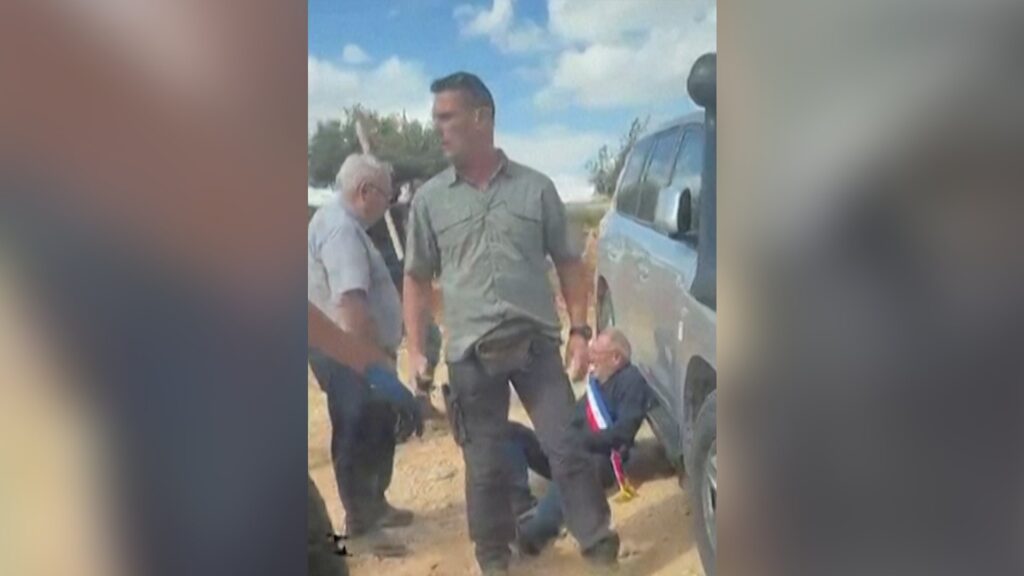
On 17 October 2026, a group of masked Israeli settlers gathered near a checkpoint outside the settlement of Ariel and launched a coordinated assault on a convoy that included several European diplomats, a French mayor visiting his hometown’s diaspora community, and nearby Palestinian residents. Witnesses reported that the assailants hurled stones, shouted nationalist slogans and used pepper spray to disperse the group, causing minor injuries to two diplomats and the mayor’s aide, according to a statement released by the French Ministry of Europe and Foreign Affairs later that day.
Palestinian eyewitnesses said the settlers’ aggression was prompted by rumors that the diplomatic delegation was planning to discuss a new settlement‑expansion plan with Israeli officials. The European diplomats, who were on a fact‑finding mission, managed to retreat to a nearby Israeli police outpost, where they received medical attention. Israeli police opened an investigation, but sources close to the security apparatus said arrests were unlikely without broader political pressure, reflecting a pattern of limited accountability for settler violence.
Why it matters: Security, diplomatic norms and the stalled peace process
The attack challenges the basic diplomatic convention of inviolability, raising questions about the safety of foreign envoys operating in contested territories. When diplomats are targeted, it not only endangers lives but also undermines the credibility of international mediation efforts, as European actors may become reluctant to engage directly on the ground. Analysts at the International Crisis Group warned that such incidents could accelerate a diplomatic pull‑back, leaving Palestinian civil‑society groups with fewer channels for external advocacy.
Beyond the immediate security concerns, the assault signals an intensifying settler militancy that coincides with a wave of new settlement approvals announced by Israel’s government earlier in the year. The timing suggests a possible strategy to intimidate any foreign scrutiny of expansion plans, a tactic that could erode the already fragile status quo and provoke wider regional instability. For the United States and the European Union, the incident adds pressure to reassess their conditionality mechanisms tied to settlement activity, potentially reshaping aid formulas and trade agreements with Israel.
African perspective: Echoes across the continent and its diaspora
Many African nations have historically supported Palestinian self‑determination, a stance that has been reinforced through the African Union’s 2020 resolution calling for an end to occupation. The attack on European officials reverberates in African capitals, where policymakers worry that escalating violence could complicate Africa‑Israel diplomatic normalization deals signed by Sudan and Chad in 2023. Critics in Nairobi and Addis Ababa argue that such agreements risk being perceived as endorsing settlement expansion if security incidents like this are not addressed.
The French mayor involved in the incident hails from a town in the French‑speaking diaspora of West Africa, where a sizable community of migrants maintains strong ties to both France and the broader African continent. Community leaders in Paris and Brussels have already mobilised protests, demanding that European governments prioritize the safety of their representatives and reaffirm support for a two‑state solution. Moreover, African NGOs operating in the West Bank, such as the Kenya‑based Peace and Justice Initiative, have warned that settler aggression could jeopardise humanitarian access for aid projects that serve both Palestinian and refugee populations across Africa and the Middle East.
What’s next: Regional reactions and possible policy shifts
In the wake of the attack, the European Union’s foreign policy chief announced a review of diplomatic security protocols in the West Bank and hinted at a possible suspension of certain joint projects with Israeli settlement councils until a thorough investigation is completed. Israel’s Ministry of Defense, however, defended the police response as "adequate" and warned that external criticism could be used by Palestinian factions to justify further unrest, a narrative echoed in a statement from the Israeli settler organization Yesha Council.
For African states, the incident may catalyse a renewed push within the African Union to adopt a unified position that couples diplomatic engagement with Israel to explicit human‑rights benchmarks. Observers expect that upcoming AU summit discussions in Addis Ababa will feature a resolution urging the EU and the United Nations to increase monitoring of settler violence and to consider targeted sanctions if accountability remains elusive. The diplomatic fallout could also influence diaspora activism, prompting African community organisations in Europe to lobby for stronger protective measures for their members serving abroad.
Quick Answers
Who were the victims of the October 2026 settler attack in the West Bank?
The assault injured several European diplomats, a French mayor’s aide, and nearby Palestinian civilians.
How might the attack affect Africa‑Israel diplomatic relations?
It could pressure African Union members to tie any normalization deals with Israel to stricter human‑rights conditions and increased monitoring of settlement activity.
What steps are European authorities taking after the incident?
The EU announced a security protocol review for its staff in the West Bank and is considering suspending some joint projects with Israeli settlement authorities pending investigation.
Source: www.aljazeera.com




💬 Comments 0