Nepal flash flood tunnel rescue saves two survivors a week after 1,300 deaths, 2026 disaster response insight
Scale of the disaster and its roots
In early September 2026, torrential monsoon rains triggered a series of flash floods along the Nepal‑Tibet border, overwhelming riverbanks and triggering landslides that cut off entire valleys. Official tallies put the death toll at more than 1,300, with thousands displaced and infrastructure such as roads, bridges and schools reduced to rubble. The worst‑hit districts, including Dolakha and Rasuwa, sit in the high Himalayas where steep slopes and fragile soils make the region especially prone to rapid runoff once the snowpack melts faster than usual.
Meteorologists attribute the severity of the event to an unusual confluence of climate drivers: a delayed but intense monsoon surge, a lingering La Niña pattern that intensified precipitation in the Indian subcontinent, and a rapid warming of the Tibetan Plateau that accelerated glacial melt. Researchers from the International Centre for Integrated Mountain Development (ICIMOD) warned weeks before the disaster that such a “compound flood” scenario was becoming more likely as climate change reshapes weather extremes in the Himalayas.
The humanitarian fallout quickly spilled beyond Nepal’s borders. Neighboring India opened emergency corridors for aid, while the United Nations Office for the Coordination of Humanitarian Affairs (UNOCHA) mobilised a $20 million appeal. Yet the sheer remoteness of many affected villages meant that conventional relief routes were blocked, forcing responders to resort to unconventional methods such as aerial drops and, eventually, tunnel rescues.
The daring tunnel rescue that broke a week‑long deadlock
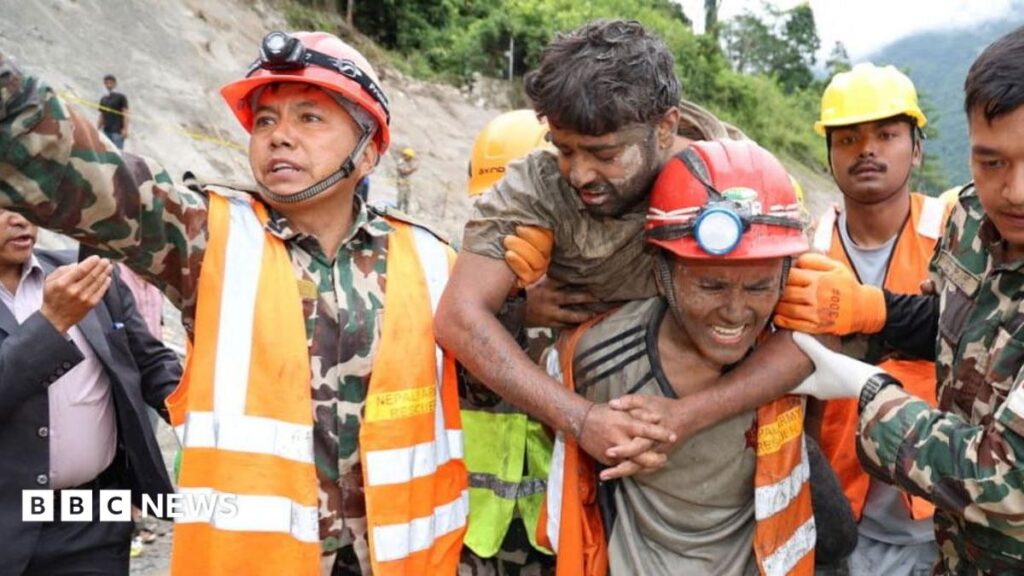
When the floodwaters receded, rescue teams discovered a collapsed tunnel that had once linked a remote hamlet to the main highway. Inside, two men—both in their thirties—were found alive, clinging to a ledge of debris after surviving more than ten days without food or clean water. The discovery came after a joint operation by Nepal’s Armed Police Force, the Nepalese Red Cross, and a team of international cave‑rescue specialists from the United Kingdom’s Mountain Rescue Service.
The operation required drilling a narrow shaft through unstable rock, installing temporary ventilation, and lowering a rope‑team equipped with harnesses and medical kits. According to a statement from the Nepalese Ministry of Home Affairs, rescuers worked in three‑hour shifts to avoid fatigue, while local volunteers passed food and water through a makeshift pulley system. After a tense 12‑hour effort, both men were hoisted to safety, wrapped in thermal blankets, and rushed to a field hospital in Kathmandu for treatment.
The rescue has been hailed as a morale‑boosting milestone for a nation still grappling with grief. Survivors’ families, many of whom had lost relatives in the same flood, described the moment as “a rare spark of hope” amid the devastation. The operation also highlighted the growing expertise of Nepal’s own disaster‑response units, which have incorporated lessons from previous earthquakes and avalanches into their training curricula.
Why the rescue matters beyond Nepal: a climate‑risk lesson for Africa and the diaspora
While the tunnel rescue is a localized story, it underscores a broader pattern of climate‑driven disasters hitting vulnerable mountainous regions across the Global South. In the past decade, African nations such as Ethiopia, Uganda and Rwanda have experienced similar flash‑flood events linked to erratic rains and glacial melt in the highlands. The shared exposure to rapid runoff and landslides means that the technical know‑how demonstrated in Nepal could be adapted for African contexts, especially where remote communities lack road access.
African NGOs and diaspora networks have already begun to take note. The Kenya‑based climate‑adaptation platform Climate Resilience Africa cited the Nepal operation in a recent briefing, urging governments to invest in “low‑tech tunnel and shaft solutions” for hard‑to‑reach flood zones. Moreover, a cohort of Nepali engineers working in South Africa’s mining sector is reportedly offering pro‑bono consultancy to help design emergency escape routes in the Drakensberg highlands, where mining tailings dams pose a comparable risk of sudden inundation.
The incident also fuels the debate on international financing for disaster risk reduction. The World Bank’s Climate Change Adaptation Fund, which allocates resources to both Himalayan and African projects, could leverage the Nepal case study to justify scaling up community‑led rescue training in regions where formal emergency services are scarce. For diaspora investors, the story signals a market for resilient infrastructure—such as modular flood‑proof shelters and portable drilling kits—that can be manufactured locally and exported to both Nepal and African flood‑prone zones.
What comes next: rebuilding, policy shifts and regional cooperation
In the wake of the rescue, Nepal’s government has pledged to conduct a comprehensive post‑disaster review, with a focus on strengthening early‑warning systems in the Himalayas. The Ministry of Home Affairs announced a new “Mountain Safety Initiative” that will fund the installation of river‑level sensors and community training programs in at least 50 high‑risk villages by 2028. Funding is expected to flow from a mix of domestic budget reallocations and international donors, including the Asian Development Bank, which has earmarked $45 million for climate‑resilient infrastructure in the country.
Cross‑border cooperation is also set to deepen. Nepal and China have agreed to share real‑time hydrological data from the Tibetan Plateau, a move that could give downstream communities precious lead‑time before flash floods strike. Meanwhile, the South Asian Association for Regional Cooperation (SAARC) is considering a joint emergency‑response protocol that would allow rapid deployment of assets—such as helicopters and medical teams—across member states during extreme weather events.
For the diaspora, the next phase presents both challenges and opportunities. Remittances, which already constitute a sizable share of Nepal’s GDP, are expected to surge as families seek to rebuild homes and livelihoods. At the same time, Nepali entrepreneurs abroad are being encouraged to invest in climate‑smart ventures back home, ranging from solar‑powered water purification units to community‑owned insurance schemes that can provide quick payouts after a disaster. The tunnel rescue, though a single act of bravery, may become a catalyst for a more coordinated, climate‑aware future across the Himalayas and beyond.
Quick Answers
How many people were rescued from the Nepal tunnel after the 2026 floods?
Two survivors were rescued from the collapsed tunnel more than a week after the floods.
What caused the flash floods that killed over 1,300 people in Nepal?
Intense monsoon rains combined with rapid glacial melt on the Nepal‑Tibet border triggered the flash floods.
How could the Nepal tunnel rescue influence disaster response in Africa?
The rescue demonstrates low‑tech tunnel and shaft techniques that African NGOs and diaspora engineers are looking to adapt for remote, flood‑prone highland communities.
Source: www.bbc.co.uk




💬 Comments 0