Ukraine releases video of strike that sinks Russian warship and hits cargo ship off Libya, March 2026
Background: Ukraine’s expanding long‑range strike capability
Since the first months of the war, Kyiv has steadily upgraded its ability to hit targets far beyond the front lines. The delivery of U.S.‑provided ATACMS missiles, the home‑grown Neptune‑K cruise missile, and a growing fleet of Turkish‑made Bayraktar TB2 drones have given Ukrainian forces a reach that now stretches into the eastern Mediterranean. Analysts at the Royal United Services Institute note that these systems have turned the conflict into a “globalized war of attrition,” where battles can be fought hundreds of kilometres from the Ukrainian border.
The strategic logic behind such strikes is two‑fold: to degrade Russia’s logistical lifelines and to force Moscow to divert resources to protect assets far from home. In recent months, Ukrainian drones have been spotted over Crimea, the Black Sea, and even the Red Sea, where they targeted vessels linked to the Russian navy or its commercial partners. The latest video from Kyiv adds Libya to that growing list of distant theatres.
What the video shows: two Russian vessels hit off Libya
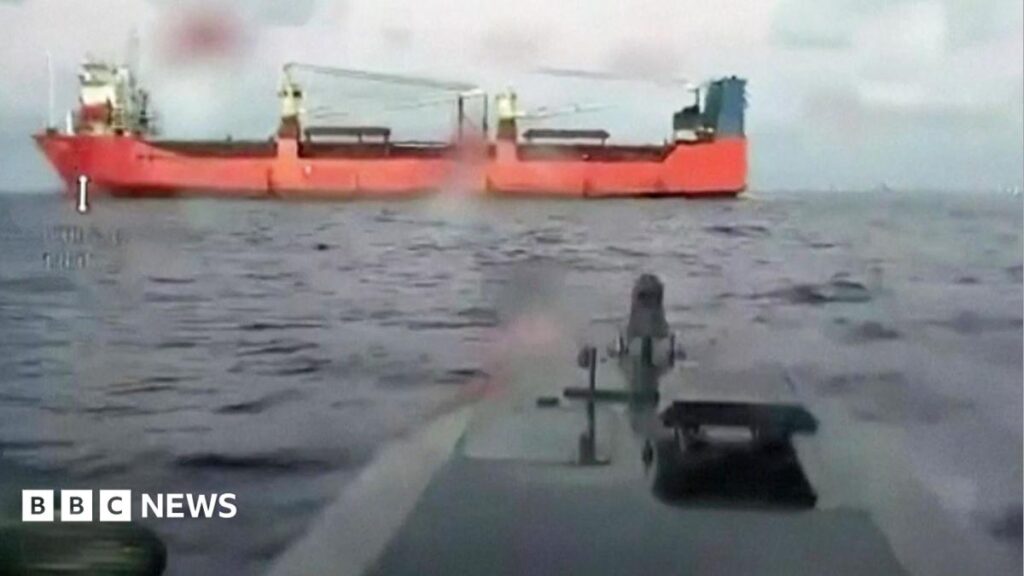
In a short clip posted on the Ukrainian president’s official Telegram channel, a bright flash erupts over the waters off the Libyan coast, followed by plumes of smoke and a sinking silhouette. President Volodymyr Zelensky later confirmed that the target was a Russian warship, identified by defence officials as the “Admiral Gorshkov” frigate, which was conducting a joint patrol with a Russian‑owned cargo carrier, the MV Krasnodar. The footage appears to capture the moment the missile struck the frigate’s bow, causing catastrophic damage that forced the crew to abandon ship.
Ukrainian officials said the strike was launched from a land‑based launch site in the Kherson region using a Neptune‑K cruise missile, a weapon that can travel up to 1,200 kilometres. The cargo ship, which was reportedly carrying oil‑related equipment, sustained a serious hull breach but remained afloat, according to a spokesperson for the Ukrainian armed forces.
Why the Libyan theatre matters for Africa and global shipping
Libya sits on one of the world’s busiest oil‑export corridors, with tankers regularly threading the Gulf of Sidra en route to Europe and the United States. Any disruption in the area reverberates across African economies that depend on steady oil revenues, especially for the fragile post‑civil‑war governments in Tripoli and the east‑west rival administrations. A sunken Russian warship signals heightened militarisation of a sea lane that already sees the presence of NATO, EU, and Libyan Coast Guard patrols.
Moreover, the incident underscores the vulnerability of foreign‑flagged vessels transiting near African shores. Shipping insurers have already raised premiums for the Mediterranean after a spate of missile attacks on commercial ships linked to the Russia‑UAE trade axis. For African importers of Russian grain and fertilizer, higher freight costs could translate into pricier food staples, a concern that food‑security watchdogs in Kenya and Nigeria have flagged as a possible secondary effect of the conflict.
Implications for Russia’s naval footprint in the Mediterranean
Moscow has used the Mediterranean as a strategic back‑door for years, maintaining a permanent naval presence in Syria’s Tartus base and rotating warships through the Suez Canal to support its Red Sea operations. The loss of a frigate near Libya, if confirmed, would be the first time a Russian warship has been sunk outside of Ukrainian waters since the war began. Defence analyst Dmitry Sokolov told TASS that Moscow is likely to reassess the risk‑vs‑reward calculus of keeping high‑value vessels near contested African ports.
A direct consequence could be a reduction in Russian naval patrols off the Libyan coast, which would open space for NATO’s maritime groups to increase their surveillance activities. That shift might also affect Russia’s commercial shipping contracts with African states that rely on Russian‑flagged vessels for oil transport, potentially prompting those countries to look for alternative partners such as China’s COSCO or European lines.
Reactions from Kyiv, Moscow and regional actors
President Zelensky hailed the operation as “a clear message that Russian aggression can be hit anywhere, even in the heart of Africa.” He added that the strike was intended to deter Russia from using its navy to support the mercenary groups fighting in Libya’s civil war. The Russian defence ministry, meanwhile, described the footage as “staged propaganda” and said an investigation was underway to verify the vessel’s status, a pattern seen in previous Ukrainian claims of distant hits.
Libyan officials in Tripoli issued a brief statement expressing “concern over any foreign military activity that could destabilise our waters.” The United Nations‑backed Libyan Joint Maritime Commission, which monitors illegal arms shipments, called for an immediate de‑escalation and urged both sides to respect the 2015 UN arms‑embargo on the country. European Union naval commanders in the Mediterranean noted that they would step up escort missions for commercial ships passing near the incident site.
What could come next: a new front in the Ukraine‑Russia war
If Ukraine can reliably strike Russian assets in the Mediterranean, it may open a new operational front that forces Moscow to stretch its anti‑air and anti‑missile defenses even thinner. Experts at the Brookings Institution argue that such “far‑field” attacks could become a regular feature of the war, especially as Ukraine continues to receive longer‑range missiles from Western allies.
For African states, the key takeaway will be how the great‑power contest spills over onto their coastlines. Nations with ports on the Mediterranean, such as Egypt, Algeria and Tunisia, will likely tighten maritime security protocols and may seek closer coordination with NATO’s Allied Maritime Command. Meanwhile, the incident could spur African Union discussions on a collective maritime security framework that can respond to both state and non‑state threats emanating from distant conflicts.
Quick Answers
Which Russian warship was reportedly sunk off Libya in March 2026?
Ukrainian officials say the frigate Admiral Gorshkov was hit and sank during the strike.
How does the strike affect African oil shipping routes?
Disruption near Libya could raise insurance costs and delay tankers that carry African oil to Europe and the US.
What weapons did Ukraine use to hit the Russian vessels?
Ukraine claimed the attack was carried out with a Neptune‑K cruise missile launched from Kherson.
Source: www.bbc.co.uk




💬 Comments 0